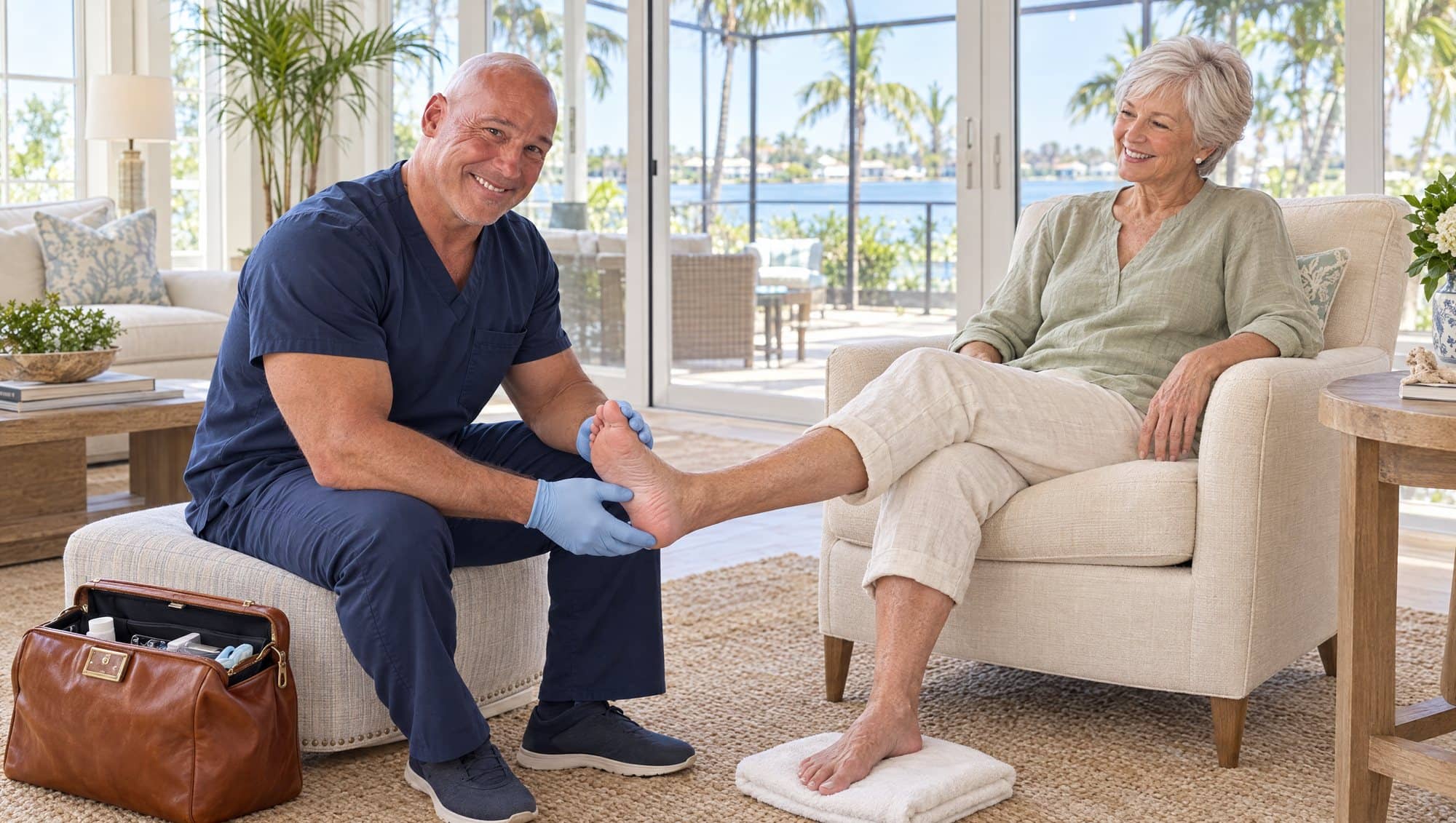
If you live with diabetes, or you help care for someone who does, your feet deserve a few minutes of attention every day. Good diabetic foot care is one of the simplest things you can do to stay comfortable, steady and independent, and it doesn’t take special equipment or much time.
I’ve been practicing podiatry since 2002, and today I do much of that work in patients’ homes around Naples. This guide is the same advice I give at the kitchen table: why diabetes affects your feet, what to do each day, what to avoid, and when to pick up the phone.
Diabetic foot care is the daily routine and regular checkups that protect feet affected by diabetes. It means looking at your feet every day, washing and drying them gently, moisturizing dry skin, trimming nails safely, wearing well-fitting shoes and socks, and having a podiatrist examine your feet at least once a year.
Below you’ll find a step-by-step daily checklist, a shoe-and-sock guide, a clear list of warning signs and what to expect at a diabetic foot exam. There are also notes for family caregivers and for life in our Southwest Florida heat.
Key takeaways
- Diabetes can quietly dull the feeling in your feet and slow healing, so small problems can grow before you notice them.
- Check both feet every day: tops, soles, heels and between every toe. A mirror, your hands or a helper can make it easy.
- Wash in warm (not hot) water, dry carefully between the toes, and moisturize the tops and soles but never between the toes.
- Wear well-fitting shoes and clean, seamless socks indoors and out. Never go barefoot, not even on the beach or pool deck.
- Call the same day about any sore that isn’t healing or any redness, warmth, swelling or drainage. A red, hot, swollen foot needs prompt care.
- Everyone with diabetes needs a complete foot exam at least once a year, and higher-risk feet need checks more often.
- If reaching your feet or getting to appointments is hard, a house-call podiatrist can do the exam and nail care at home.
In this article· 14 sections
- 1Why diabetes puts your feet at risk
- 2Your daily diabetic foot care routine
- 3Washing, drying and moisturizing the right way
- 4Can people with diabetes cut their own toenails?
- 5Diabetic socks and shoes: what to wear and what to skip
- 6Diabetic foot care in the Naples heat
- 7Everyday habits that protect your feet
- 8Warning signs: when to call a podiatrist
- 9What happens at a diabetic foot exam
- 10How often should you see a podiatrist with diabetes?
- 11A caregiver’s guide to diabetic foot care
- 12Diabetic foot care at home: house calls and Medicare
- 13Common questions
- 14Sources
Why diabetes puts your feet at risk
Diabetes affects the whole body, but the feet often feel it first. They’re the farthest point from your heart, they carry your weight all day, and they spend most of their time hidden inside shoes.
Two changes do most of the damage: nerve damage and reduced blood flow. Each one is a problem on its own. Together, they explain why a small blister can matter so much more when you have diabetes.
Nerve damage (diabetic neuropathy)
Over time, high blood sugar can injure the nerves that carry feeling from your feet to your brain. This is called diabetic peripheral neuropathy. According to the CDC, about half of all people with diabetes have some kind of nerve damage.
Neuropathy can feel like tingling, burning, “pins and needles” or sharp pain. Or it can feel like nothing at all, and that second kind is the tricky one. When feeling fades, you may not notice a pebble in your shoe, a blister from new sandals, or bath water that’s too hot.
Doctors call this loss of protective sensation. The early-warning pain that normally makes you stop and look has been turned down. You can still walk, but your feet can no longer tell you when something is hurting them.
Nerve damage can also affect the small muscles of the foot and the glands that keep skin moist. The American Diabetes Association (ADA) notes that this can leave the skin very dry, so it peels and cracks, and that neuropathy can change the shape of the feet and toes over time.
Good to know
Neuropathy can be completely silent. International diabetic foot guidelines point out that having no symptoms doesn’t rule out foot problems. You can have reduced feeling, poor circulation, or even a sore, without any pain at all. That’s why the daily look and the yearly exam matter even when your feet feel fine.
Reduced blood flow
Diabetes also makes it more likely that the arteries in your legs will narrow and harden, a condition called peripheral artery disease (PAD). The ADA explains that poor circulation makes the foot less able to fight infection and heal.
Signs of reduced circulation can include aching or cramping in the calves when you walk that eases when you rest, feet that look pale or feel cold, and less hair on the feet and lower legs. Smoking makes circulation problems worse because it damages blood vessels.
How a small problem becomes a big one
Put those two changes together and the risk becomes clear. A shoe rubs, and you don’t feel it. A blister forms and breaks open. Because blood flow is reduced, it heals slowly, and an open sore is a doorway for bacteria.
An open sore that doesn’t heal is called an ulcer. The ADA says ulcers most often form on the ball of the foot or the bottom of the big toe, the places that take the most pressure.
Even ulcers that don’t hurt need attention. The ADA is clear that every ulcer should be seen by a doctor right away, because a neglected ulcer can become infected and, in the worst cases, lead to amputation.
Here is the hopeful part: the ADA also says most limb loss from diabetes is preventable. Daily checks, sensible shoes and regular professional care catch problems while they’re still small and easier to treat.
Other foot changes to watch
- Calluses. According to the ADA, calluses form more often and build up faster with diabetes. Left alone, a thick callus can break down into an ulcer underneath.
- Dry, cracked heels. Cracks in the skin let germs in.
- Nail problems. Thick, discolored or ingrown nails can press on the skin around them.
- Shape changes. Hammertoes and bunions change where pressure falls. Rarely, nerve damage leads to Charcot foot, in which bones and joints in a numb foot weaken and the foot changes shape.
Your daily diabetic foot care routine
The most important diabetic foot care happens at home, and it takes about as long as brushing your teeth. Here is the routine I suggest.
Do it at the same time every day so it becomes automatic. After your shower or bath works well, and so does the moment you change for bed.
Set yourself up safely
- Sit in a sturdy chair, in good light. Never balance on one leg to see your foot.
- Keep your reading glasses, a hand mirror and a towel within reach.
- If you use a cane or walker, keep it close so you’re never tempted to stand up quickly.
The two-minute foot check
Work through both feet the same way, every time:
- Tops of the feet: the skin, the toes and the knuckles of the toes.
- Soles and heels: lift each foot onto the opposite knee or use a mirror.
- Between every toe: gently spread the toes apart and look at the skin in each space.
- Toenails: the edges and corners, the color, and whether any nail is getting thicker.
- Backs of the heels and sides of the feet: the spots where shoes rub most.
- Feel as well as look: run your hands over both feet and compare them. Notice any spot that feels warmer, cooler, swollen or tender.
- Socks and shoes: look for blood or drainage on your socks, and feel inside your shoes for pebbles, rough seams or torn linings.
International guidelines ask people with diabetes to inspect the entire surface of both feet every day, including between the toes, and to look inside and feel inside their shoes before putting them on. This checklist covers all of it.
What you’re looking for
Anything new is worth noticing. In particular, look for:
- Cuts, scrapes, scratches or puncture marks
- Blisters, red spots or areas of swelling
- Cracks in the skin, especially around the heels
- Corns and calluses, and any callus with dark, dried blood inside
- Ingrown toenails, or nails that are thick, yellow or crumbly
- Changes in skin color or temperature
- Moist, peeling or white skin between the toes, which can be a sign of athlete’s foot
- A sore that is draining or smells unpleasant
If something looks different, compare it with the other foot, then check it again the next day. If it isn’t clearly getting better within a day or two, or if it looks infected, call your podiatrist.
If you can’t see or reach your feet
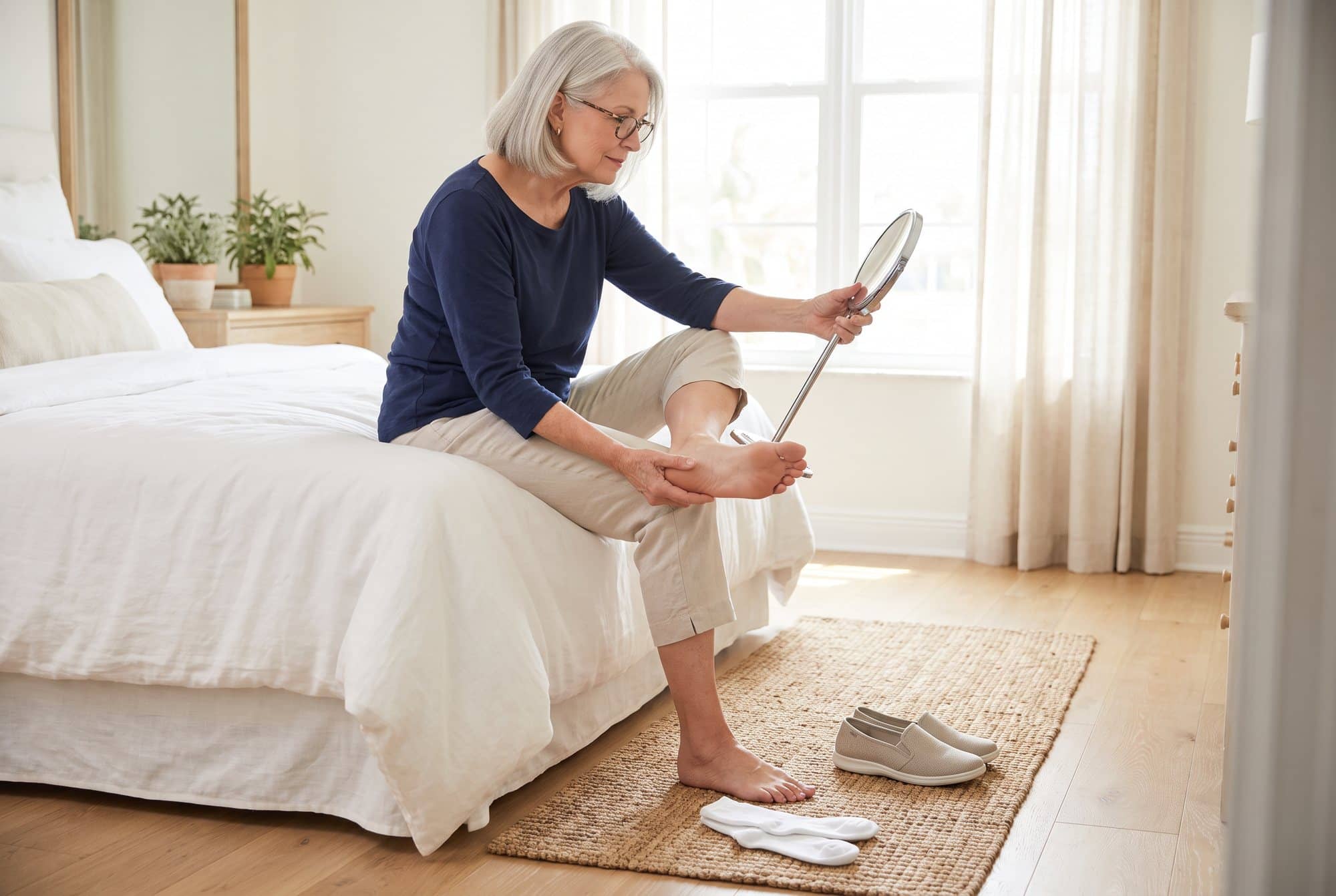
Stiff hips, a sore back, extra weight or poor eyesight can make a foot check hard. You still have good options:
- Use a mirror. An unbreakable hand mirror, or one with a long handle, lets you see your soles without twisting. The ADA’s standards of care specifically mention checking your feet with an unbreakable mirror or by feel.
- Use your hands. Running your fingers over your feet can pick up swelling, warmth, cracks and rough spots, even when you can’t see them well.
- Use your phone. Take a photo of each sole and zoom in. It also gives you a picture to show your podiatrist later.
- Ask for help. A spouse, adult child or caregiver can do the check in a minute or two. The CDC recommends asking a family member to help if you need it.
Washing, drying and moisturizing the right way
Clean, dry, supple skin is your feet’s first line of defense. A few small details make a big difference.
Wash every day, in warm (not hot) water
Wash your feet daily with mild soap and warm water. Test the water with your elbow or a bath thermometer first, never with your foot, because a numb foot can’t judge temperature. The National Institute of Diabetes and Digestive and Kidney Diseases (NIDDK) suggests water between 90°F and 95°F.
Keep it brief. The CDC advises against soaking your feet, so wash, rinse and you’re done.
Dry gently, especially between the toes
Pat your feet dry with a soft towel instead of rubbing, and take extra care between the toes. Moisture trapped there softens the skin and invites fungal infections such as athlete’s foot.
NIDDK notes that a light dusting of talcum powder or cornstarch between the toes can help keep those spaces dry. A clean, dry towel used only for your feet is a good habit too.
Moisturize the tops and soles, but not between the toes
Diabetes can leave the skin of the feet very dry, and dry skin cracks. After washing, rub a thin layer of moisturizing cream or lotion into the tops and soles of your feet, paying extra attention to the heels.
Skip the spaces between the toes. The CDC advises against putting lotion there because the extra moisture can lead to infection.
A plain, unscented cream works well for most people. Before you use any medicated cream, heel treatment or callus product, ask your podiatrist whether it’s right for your skin.
Corns and calluses: put down the razor
It’s tempting to shave a callus with a razor blade, trim it with scissors, or reach for a drugstore corn pad. Please don’t. The ADA warns against over-the-counter corn and callus removers because the acids in them can harm your skin, and international guidelines advise against chemical agents and plasters for corns and calluses.
A slip of the blade on skin you can’t fully feel can open a wound that is slow to heal. NIDDK advises never cutting corns or calluses yourself.
If your podiatrist says it’s appropriate, a pumice stone used gently, moving in one direction, can keep calluses from building up. Thick or painful calluses should be reduced by a podiatrist with sterile instruments. You can read more in our guide to corns and calluses in older adults.
Daily skin care at a glance
| Do this | Not this |
|---|---|
| Wash daily in warm water, tested with your elbow | Soak your feet or use hot water |
| Pat dry, especially between the toes | Leave the spaces between your toes damp |
| Moisturize the tops, soles and heels | Put lotion between your toes |
| Use a pumice stone gently, if your podiatrist agrees | Cut corns or calluses, or use medicated corn pads |
| Keep feet warm with clean socks | Warm your feet with heating pads, hot-water bottles or heaters |
NIDDK and international guidelines both warn against heating pads, hot-water bottles and heaters on your feet. With reduced feeling, a burn can happen before you notice the heat.
Can people with diabetes cut their own toenails?
Often, yes, with care. If your nails are thin and healthy, you can see and reach them comfortably, and you still have good feeling in your toes, trimming at home is usually fine. The CDC recommends trimming toenails straight across and smoothing any sharp edges with a nail file.
There are also times when a podiatrist should do it. NIDDK advises having a foot doctor trim your nails if you can’t see or reach your feet, or if your nails are thick or yellowed.
How to trim safely at home
- Trim after washing, when the nails are softer.
- Sit in good light with your foot resting on a towel, not held up in the air.
- Use a clean toenail clipper with a straight edge. Fingernail clippers are too small for most toenails.
- Cut straight across. Don’t round the corners or dig down into the sides; that’s how many ingrown toenails start.
- Don’t cut too short. Leave a thin white edge of nail.
- Smooth the edges with an emery board so a sharp corner can’t scratch the next toe.
- Never dig under a nail or into a corner with scissors, files or other sharp tools.
When to let a podiatrist handle it
Ask for professional nail care if:
- Your nails are thick, curved, crumbly or discolored
- You have numbness, burning or tingling in your feet
- You’ve been told you have poor circulation, or you’ve had a foot ulcer before
- Your eyesight, hands or flexibility make it hard to see what you’re doing
- A nail edge keeps growing into the skin
Thick nails are common with age, and they deserve their own guide: see thick toenails in older adults. If a nail edge is red, swollen or draining, please don’t attempt bathroom surgery. Read about ingrown toenail treatment and give us a call instead.
Diabetic socks and shoes: what to wear and what to skip
Shoes are where many foot injuries begin, and the right pair is also one of the simplest ways to prevent them. International guidelines name ill-fitting footwear and walking barefoot as major causes of the injuries that turn into ulcers in people with diabetes.
Never go barefoot, even at home
Wear shoes, or supportive house shoes, with socks at all times, indoors and out. That includes the trip to the bathroom at night and the walk across the pool deck.
The guidelines also advise against walking around in socks alone or in thin-soled slippers. A closed-back house shoe with a firm, non-slip sole is a much safer choice.
What to look for in socks
The ADA suggests socks that are:
- Light-colored, so you’ll notice blood or drainage right away
- Seamless, or with flat seams, so nothing rubs
- Moisture-wicking, made from synthetic fibers or wool blends that pull sweat away from the skin
- Padded where you need extra cushioning
- Well-fitting, never bunched, and not too tight around the leg
Change your socks every day, and sooner if they get damp. International guidelines also caution against tight or knee-high socks. Compression socks help some people with swelling, but ask your doctor or podiatrist first, because they aren’t right for everyone.
“Diabetic socks” in stores usually just means socks with these features. You don’t need anything fancy, only the right features and a clean pair every day.
What to look for in shoes
A good shoe for diabetic feet protects, cushions and matches the shape of your foot:
- Length: about a thumbnail’s width of space beyond your longest toe. International guidelines suggest the inside of the shoe be 1 to 2 centimeters (roughly half an inch) longer than your foot.
- Width: as wide as the widest part of your foot, with a roomy, rounded toe box so your toes aren’t squeezed.
- Depth: enough height inside that the tops of your toes don’t rub.
- Closure: laces or hook-and-loop straps you can adjust if your feet swell.
- Sole: cushioned, firm and non-slip.
- Inside: a smooth lining with no rough seams or bumps.
NIDDK recommends avoiding pointed toes, high heels, and shoes made of vinyl or plastic, which don’t stretch or breathe. Walking shoes and athletic shoes are often a good choice.
How to shop for shoes
- Have both feet measured whenever you buy shoes. Feet can change size and shape over the years.
- Shop later in the day, when feet tend to be a little swollen, and try shoes on while standing.
- Wear the socks you’ll actually wear with them.
- Break new shoes in slowly, a short stretch at a time, and check your feet after each wear.
- Before putting any shoe on, feel inside for pebbles, sand, torn linings or anything poking through.
Shoes and socks at a glance
| Look for | Skip | |
|---|---|---|
| Socks | Light-colored, seamless, moisture-wicking, padded | Tight elastic tops, rough seams, socks that stay damp |
| Everyday shoes | Roomy rounded toe box, cushioned non-slip sole, laces or straps | Pointed toes, high heels, vinyl or plastic uppers |
| At home | Closed-back house shoes with a firm, non-slip sole | Bare feet, socks alone, thin floppy slippers |
| Beach and pool | Water shoes or closed-toe sandals with a back strap | Bare feet, flip-flops |

Therapeutic shoes and Medicare
If you have diabetes along with certain foot problems, specially made therapeutic shoes and inserts can take pressure off vulnerable spots. The ADA’s standards of care recommend specialized therapeutic footwear for people at high risk of ulcers, including those with loss of feeling, foot deformities, calluses, poor circulation, or a past ulcer or amputation.
Medicare Part B helps pay for therapeutic shoes for people with diabetes and severe diabetes-related foot disease. Each calendar year, Medicare covers either one pair of custom-molded shoes plus two extra pairs of inserts, or one pair of extra-depth shoes plus three pairs of inserts.
There are a few requirements. The doctor who treats your diabetes must certify that you need them, a podiatrist or other qualified doctor must order them, and they must come from a supplier enrolled in Medicare. After the Part B deductible, you generally pay 20% of the Medicare-approved amount if the supplier accepts assignment.
Diabetic foot care in the Naples heat
Life in Southwest Florida is wonderful for staying active, from beach walks and pool laps to evenings on the lanai. But heat, sand and sandals call for a few extra precautions when you have diabetes.
Heat and humidity
The CDC explains that diabetes-related nerve and blood vessel damage can affect your sweat glands, so your body can’t cool itself as well. People with diabetes also tend to become dehydrated more quickly.
Drink water through the day, plan outdoor time for the cooler morning and evening hours, and spend the hottest part of the day in air-conditioning. Heat can also damage insulin, test strips and glucose meters, so keep your supplies out of hot cars and direct sun, including at the beach and by the pool.
Humidity keeps feet damp, and damp skin between the toes is where athlete’s foot gets started. Change out of sweaty socks, dry carefully between your toes after the beach or pool, and give your shoes a chance to air out between wearings.
Sand, pavement and pool decks
Midday sand, asphalt, boardwalks and pool decks can be hot enough to burn. With reduced feeling, you might not notice until a blister has already formed. NIDDK advises wearing shoes on the beach and on hot pavement, and the CDC says never to go barefoot, even at the beach or pool.
- Wear water shoes or closed-toe sandals with a back strap on the sand and in the water.
- Shake out sand before you put your shoes back on, and check for bits of shell and grit.
- Put sunscreen on the tops of your feet. The CDC notes that sunburn can raise blood sugar.
- Rinse and dry your feet when you get home, then do a quick foot check.
A word about sandals and flip-flops
In Naples, sandals are practically a uniform. Flip-flops and open shoes, though, leave your toes exposed to stubs, scrapes and sunburn, and the ADA recommends avoiding them if you have diabetes.
If you want a lighter shoe for warm days, look for a closed-toe sandal with a cushioned sole and a strap around the heel, and ask your podiatrist whether it suits your feet. Footwear also plays a big part in staying steady on your feet; our guide to feet, balance and fall prevention covers what to look for.
Everyday habits that protect your feet
Daily checks and good shoes are the foundation. These habits support everything else you do:
- Work with your care team on blood sugar. Keeping your blood sugar in the range your doctor recommends helps protect your nerves and blood vessels over time. Take your medicines as prescribed, and talk with your doctor before changing anything.
- Don’t smoke. Smoking damages blood vessels and reduces circulation to the feet. If you smoke, ask your doctor about help quitting; the ADA recommends smoking-cessation support as part of preventive foot care.
- Keep moving. Walking, swimming, cycling and chair exercises keep blood flowing. NIDDK suggests wiggling your toes and moving your ankles throughout the day, especially when you’ve been sitting for a while.
- Build strength and balance. Strong legs and good balance make every step safer. Our guide to strength training after 60 is a practical place to start, and Dr. Losier’s wellness coaching covers strength, balance and everyday healthy habits as part of foot care.
- Keep your feet warm the safe way. If your feet get cold at night, wear clean, loose socks to bed rather than using a heating pad.
Warning signs: when to call a podiatrist
Most foot problems in diabetes start small and get worse quietly. That’s why I’d always rather hear from you early.
Keep in mind that nerve damage and poor circulation can mute the usual signs of infection. International guidelines note that redness, warmth and pain may be blunted, so a problem can be more serious than it looks or feels. If you’re unsure, call.
| Warning sign | What it may mean | What to do |
|---|---|---|
| An open sore, or a cut or blister that isn’t healing after a few days | An ulcer may be forming | Call the same day and keep pressure off it |
| Redness, warmth, swelling, pain or pus around a wound or nail | Infection | Call the same day |
| A foot that’s suddenly red, hot and swollen, even without pain or an injury | Infection or Charcot foot | Get seen the same day |
| Skin turning black, or a foul smell from a wound | Tissue damage (gangrene) | Seek emergency care |
| Fever, chills or spreading redness along with a foot wound | A spreading infection | Seek emergency care |
| A callus with dark, dried blood inside | Pressure damage under the skin | Call for an appointment soon |
| An ingrown toenail, or nails that are thick, yellow or crumbly | A nail problem or fungal infection | Book a visit |
| New numbness, tingling or burning | Changes in the nerves | Mention it soon to your doctor or podiatrist |
| Calf pain when walking that eases with rest, or cold, pale feet | Reduced circulation | Call your doctor or podiatrist |
| A change in the shape of your foot | Changes in the bones or joints | Call for an exam |
When to call a podiatrist
Call the same day for any open sore, any sign of infection (redness, warmth, swelling, pain, drainage or odor), or a foot that’s suddenly red, hot and swollen. If you see black skin, or you have fever, chills or spreading redness along with a foot wound, go to an emergency room or call 911. Don’t wait for your next scheduled visit.
What to do while you wait to be seen
- Keep the area clean and covered with a clean, dry dressing.
- Stay off the foot as much as you can.
- Don’t pop blisters, cut calluses or try to dig out a nail.
- Don’t soak the foot or put heat on it.
- Note when you first noticed the problem, and take a photo to show the doctor.

House calls in Naples
Rather have Dr. Losier take a look?
He comes to your home with sterile instruments and everything needed for the visit. We’ll check your benefits before your visit, so you’ll know what’s covered (and any cost) ahead of time.
What happens at a diabetic foot exam
A diabetic foot exam is quick, gentle and one of the most useful checkups you can have. The American Diabetes Association recommends a comprehensive foot exam at least once a year for everyone with diabetes. People who have lost feeling in their feet, or who have had an ulcer or amputation, should have their feet checked at every visit.
The ADA also recommends that checks for nerve damage begin at diagnosis for type 2 diabetes and five years after diagnosis for type 1, then continue at least yearly. Here’s what that exam looks like when I visit patients at home.
Your history, in your own words
We start with a conversation. I’ll ask how long you’ve had diabetes, about any numbness or pain, past sores or foot surgery, circulation problems, smoking and how much you’re walking.
I also ask what’s hard for you. Reaching your feet, trimming your nails and finding shoes that fit are common challenges, and each one shapes the plan.
Skin and nails
I look at every part of both feet, including between the toes and around the heels. I’m checking for dryness, cracks, calluses, corns, blisters, color changes and any sign of infection.
Then I check each toenail for thickness, ingrown edges and signs of fungus. Nails that are hard to manage at home can usually be trimmed and thinned during the same visit.
Sensation: the monofilament test
To check protective sensation, I use a 10-gram monofilament, a thin nylon fiber that looks like a stiff piece of fishing line. With your eyes closed, I touch it to several spots on your soles until it bends slightly, and you say “yes” each time you feel it.
The ADA recommends the monofilament test along with at least one more quick check, such as vibration with a tuning fork, a light pinprick, or a temperature test. All of these are quick and gentle.
Medicare uses the same idea. One way it defines loss of protective sensation is not feeling the monofilament at two or more of five tested spots on either foot.
Circulation
I feel for the pulses on the top of your foot and behind the inside ankle bone. I also check skin color, temperature, and how quickly color returns after a gentle press on a toe.
If circulation looks reduced, the ADA recommends further testing, such as an ankle-brachial index. That’s a simple, painless test comparing blood pressure in your ankle and your arm, usually arranged with your physician or a vascular specialist.
Foot shape, shoes and walking
I look for bunions, hammertoes, flat or high arches and any bony spots that take extra pressure, both while you’re sitting and while you’re standing. International guidelines recommend examining the feet both ways, because problems can show up under your full weight.
I’ll also look at the shoes and slippers you actually wear, which is one big advantage of a home visit, and watch how you walk in them.
Care that day, and a clear plan
Many problems can be treated during the same visit, such as trimming and thinning thick nails or carefully reducing calluses with sterile instruments. Before I leave, you’ll know your risk level, what to watch for, and when I’d like to see you again.
How often should you see a podiatrist with diabetes?
The short answer: at least once a year, and more often if your feet are at higher risk. The CDC recommends having your feet checked at every primary care visit and seeing a foot doctor every year, or more often if you have nerve damage.
The International Working Group on the Diabetic Foot groups people by risk and suggests how often their feet should be screened:
| Risk level | What it usually means | Suggested foot screening |
|---|---|---|
| Very low | Normal feeling and good circulation | Once a year |
| Low | Loss of feeling or reduced circulation | Every 6 to 12 months |
| Moderate | Two risk factors together, such as loss of feeling plus poor circulation or a foot deformity | Every 3 to 6 months |
| High | Loss of feeling or poor circulation, plus a past ulcer or amputation, or end-stage kidney disease | Every 1 to 3 months |
These are general guides, and your podiatrist will set a schedule that fits your feet. Medicare has its own rules about how often it pays for diabetic foot care, which we explain in the Medicare section below.
A caregiver’s guide to diabetic foot care
If you’re helping a parent or spouse with diabetes, you can make a real difference in a few minutes a day. Many older adults can’t easily see or reach their own feet. Some won’t mention a problem because they don’t want to be a bother, and some truly can’t feel it.
Fold foot checks into the day
The easiest time is when you’re already helping, such as after a shower, while putting on socks, or when getting ready for bed. Use the same two-minute checklist above, in good light, and look between every toe.
Explain what you’re doing and why. Many people welcome a second set of eyes once they understand that it’s about keeping them walking.
Watch for clues
People with memory loss or reduced feeling may not tell you something is wrong. Watch for:
- Limping, walking differently, or not wanting to walk
- Wincing when putting on shoes
- Spots of blood or drainage on socks or bedsheets
- A new smell from the feet or shoes
- Shoes that suddenly seem tight, or swelling by the end of the day
- Toenails that are getting long, thick or hard to cut
Help with socks and shoes
Smooth out socks so there are no wrinkles, and make sure the tops don’t leave deep marks. Check inside shoes before every wear.
Keep closed-back slippers with non-slip soles right beside the bed, so bare feet never touch the floor at night. That one habit protects feet and helps prevent slips on the way to the bathroom.
Keep a simple foot log
A notebook or a note on your phone is enough: the date, anything you noticed, and a photo if something changes. Bring it to appointments. It helps the podiatrist see changes over time that are easy to forget.
Speak up at medical visits
Ask the primary care doctor to look at the feet at every visit; taking off shoes and socks in the exam room is a simple reminder. Make sure a podiatrist examines both feet at least once a year, and more often if they’ve told you the feet are at higher risk.
Caregiver note
You don’t have to do nail or callus care yourself. With diabetes, it’s often safer not to. Your most important job is to look, notice and call. If getting your parent to appointments is hard, a house-call podiatrist can come to them, and you’re welcome to join the visit.
If your parent lives in assisted living or a nursing home, ask whether the community offers podiatry visits on site. Our article on podiatry services for nursing homes and assisted living explains how that usually works.

House calls in Naples
Rather have Dr. Losier take a look?
He comes to your home with sterile instruments and everything needed for the visit. We’ll check your benefits before your visit, so you’ll know what’s covered (and any cost) ahead of time.
Diabetic foot care at home: house calls and Medicare
How house calls help when getting out is hard
For many people with diabetes, the hardest part of foot care isn’t the care itself; it’s getting to it. Driving, parking, walkers, wheelchairs and waiting rooms all add up. And the people who find it hardest to get out are often the same people who benefit most from regular foot checks.
A house call takes those obstacles off the table. When I visit you at home in Naples or nearby communities such as Pelican Bay, Port Royal, Marco Island, Bonita Springs or Estero, I bring sterile instruments and everything needed for a complete diabetic foot exam and nail care.
A home visit also lets me see things an office can’t: the shoes and slippers you really wear, the chair where you check your feet, the lighting in your bathroom, and the rugs and steps you walk on every day. Family members are welcome to join, ask questions and learn the daily check alongside you.
You can see how house calls work, read what to expect from a house-call podiatrist, or learn more about Dr. Losier.
What Medicare covers for diabetic foot care
Medicare’s rules can be confusing, so here’s the short version:
- Routine foot care, such as trimming nails or removing corns and calluses, generally isn’t covered on its own.
- Diabetes with nerve damage is different. If you have diabetic peripheral neuropathy with loss of protective sensation, Medicare Part B covers a foot exam and treatment every six months, as long as you haven’t seen a foot care professional for another reason in between. That treatment can include care for calluses and toenails.
- Medically necessary treatment for foot injuries and diseases is covered.
- Therapeutic shoes and inserts are covered for people who qualify, as described above.
For covered services, you generally pay 20% of the Medicare-approved amount after the Part B deductible. If you have a Medicare Advantage plan, your costs and rules, such as networks or referrals, may differ. For the full picture, read Does Medicare cover podiatry?
Insurance and getting started
Dr. Losier works with Medicare, Medicaid, Aetna, Cigna, Humana and UnitedHealthcare, and more plans are being added. Coverage depends on your plan and your health, so we’ll check your benefits before your visit, and you’ll know what’s covered (and any cost) ahead of time.
See the insurance details, or request a visit and we’ll call you back to find a time that works.
The bottom line
Diabetic foot care isn’t complicated. It’s a two-minute look every day, gentle care for your skin and nails, shoes that fit, and a podiatrist who knows your feet. Small habits, done consistently, help keep you walking the beach, playing with the grandkids and living life on your own terms.
This article is general information, not medical advice. If you have diabetes, talk with your doctor or podiatrist about the right foot care plan for you, and seek care right away for any wound, sign of infection or sudden change in your feet.
Common questions
Everyone with diabetes should have a complete foot exam at least once a year. If you have numbness, poor circulation, a foot deformity or a past ulcer, your feet need checking more often: every 6 to 12 months at lower risk, and as often as every 1 to 3 months for the highest-risk feet. Your podiatrist will suggest a schedule based on your exam.
Many people with diabetes can, if their nails are thin, they can see and reach their feet comfortably, and they still have good feeling in their toes. Trim straight across after washing and smooth the edges with a file. If your nails are thick, curved or hard to reach, or you have numbness or poor circulation, let a podiatrist trim them.
Look for cuts, blisters, red spots, swelling, cracks, corns or calluses, ingrown or discolored nails, and changes in skin color or temperature. Check the tops, soles, heels and between every toe. Anything new that isn’t clearly improving within a day or two deserves a call.
The skin between the toes stays warm and closed in, so extra moisture there softens the skin and can lead to infection. Moisturize the tops and soles of your feet to prevent cracks, and keep the spaces between your toes clean and dry.
Medicare Part B can help pay for therapeutic shoes and inserts for people with diabetes and severe diabetes-related foot disease: each calendar year, either one pair of custom-molded shoes with two extra pairs of inserts, or one pair of extra-depth shoes with three pairs of inserts. Your doctor must certify the need, and the shoes must come from a Medicare-enrolled supplier. The Part B deductible and 20% coinsurance generally apply.
The exam includes a close look at your skin and nails, a check for deformities such as bunions or hammertoes, a sensation test with a thin nylon monofilament plus one other quick test, and a circulation check that includes feeling the pulses in your feet. It takes only a few minutes, and the tests are gentle.
It’s safer not to. Hot sand, shells and boardwalks can burn or cut feet that may not fully feel the injury. Wear water shoes or closed-toe sandals with a back strap, and check your feet when you get home.
Yes. Dr. Losier makes house calls in Naples and nearby communities and brings everything needed for a complete diabetic foot exam and nail care. Coverage depends on your plan, so we check your benefits before your visit.
Don’t see your question? Call (914) 844-8024 — a real person will help.
Sources
The health, safety and coverage facts in this article are based on these sources.
- CDC — Diabetes and Your Feetcdc.gov(opens in a new tab)
- NIDDK (National Institutes of Health) — Diabetes & Foot Problemsniddk.nih.gov(opens in a new tab)
- American Diabetes Association — Standards of Care in Diabetes: Retinopathy, Neuropathy, and Foot Carepmc.ncbi.nlm.nih.gov(opens in a new tab)
- American Diabetes Association — Diabetes & Your Feetdiabetes.org(opens in a new tab)
- American Diabetes Association — 8 Tips to Protect Your Feet with Diabetesdiabetes.org(opens in a new tab)
- International Working Group on the Diabetic Foot (IWGDF) — Practical Guidelines on the Prevention and Management of Diabetes-Related Foot Diseaseiwgdfguidelines.org(opens in a new tab)
- Medicare.gov — Foot care (for diabetes)medicare.gov(opens in a new tab)
- Medicare.gov — Therapeutic shoes or insertsmedicare.gov(opens in a new tab)
- CDC — Managing Diabetes in the Heatcdc.gov(opens in a new tab)
- Medicare.gov — Foot care coveragemedicare.gov(opens in a new tab)
About the author
Robert Losier, DPM
Doctor of Podiatric Medicine · Practicing since 2002
Dr. Robert Losier is a Florida-licensed podiatric physician who brings unhurried foot care to patients’ homes across Naples and Southwest Florida, and on-site podiatry to care communities. A graduate of the New York College of Podiatric Medicine, he lives what he teaches — daily movement, strength training and real food — and shares practical healthy-living guidance as part of foot care.
This article is general information, not medical advice. It isn’t a substitute for an exam or for advice from your own doctor or podiatrist about your situation. Please don’t start, stop or change any medication or treatment without talking to the clinician who prescribed it. If you notice a new wound, signs of infection, or a sudden change in the color, temperature or feeling of your foot — especially if you have diabetes — contact your doctor promptly. In an emergency, call 911.