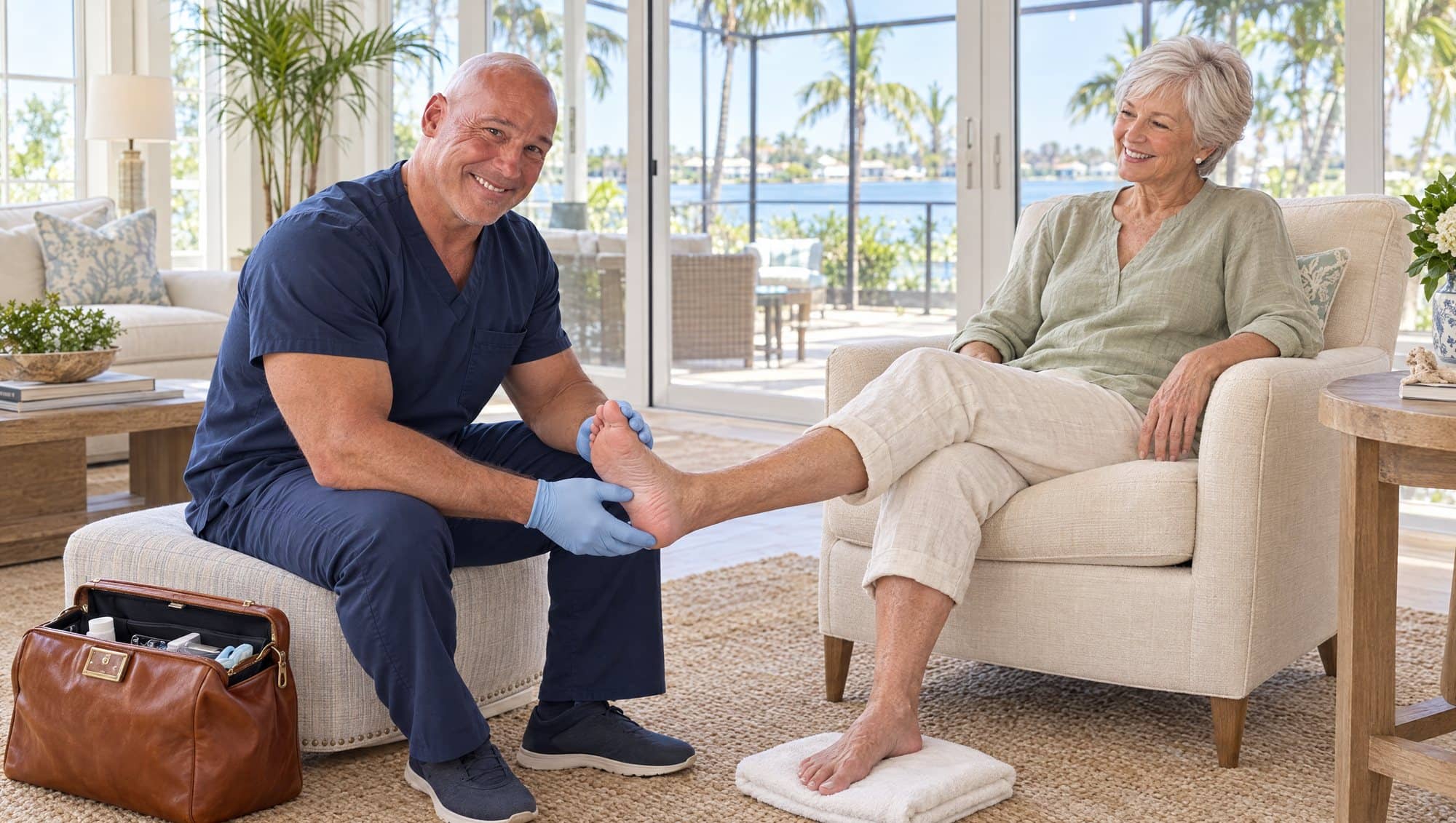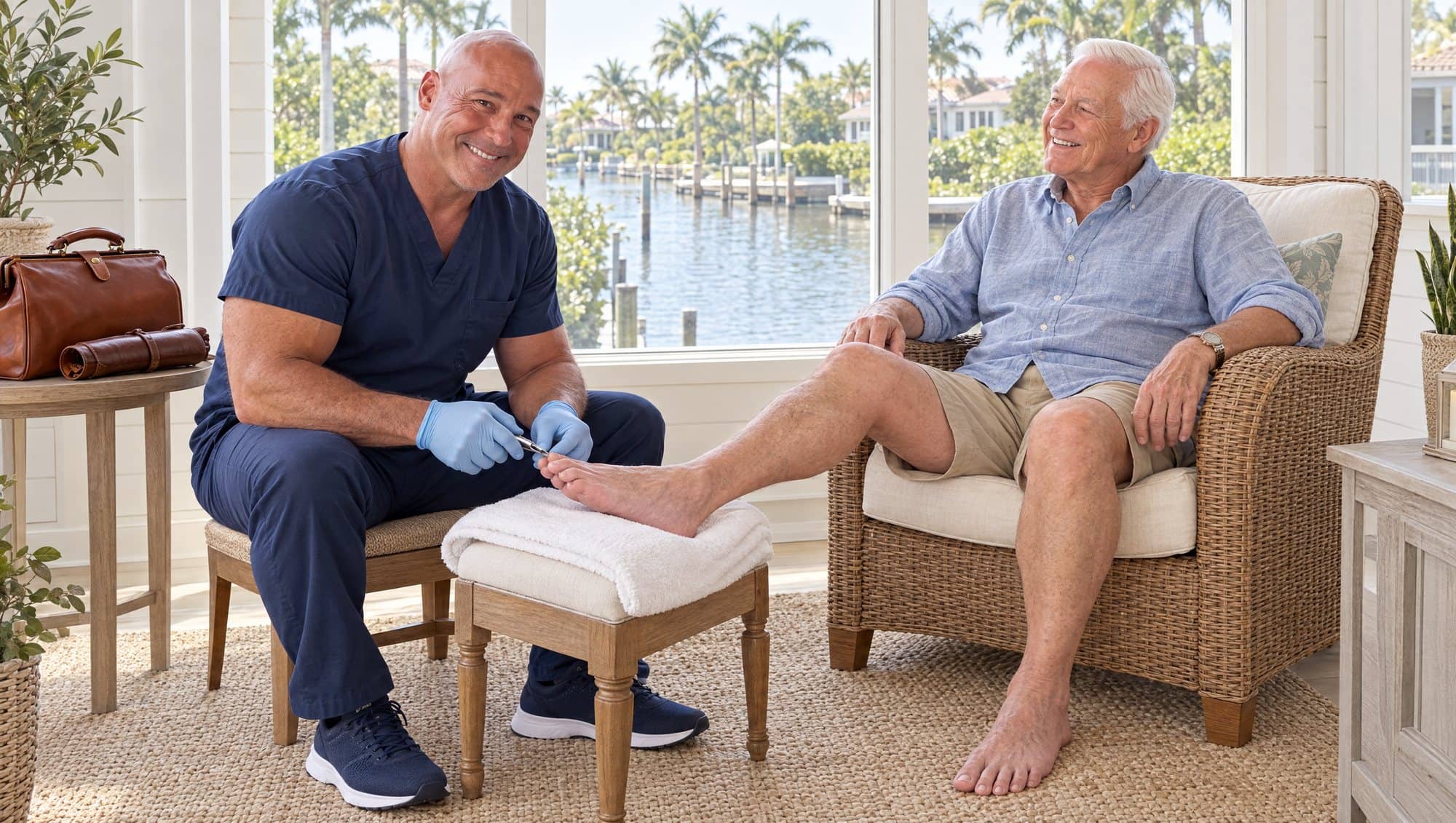
Getting to a foot appointment can be the hardest part of foot care. There's the drive (in season, a short hop down US-41 can take a while), the parking lot, the waiting room, and the shoes and socks that come off and go back on. For many people in their seventies, eighties and nineties — and for the families who drive them — that trip can be the reason a sore nail or a painful callus gets put off for months.
A house call podiatrist turns that around. The appointment comes to you: a licensed foot doctor at your door, with sterile instruments and time to do things properly, while you sit in your own chair.
In plain terms, a house call podiatrist is a licensed Doctor of Podiatric Medicine (DPM) who examines and treats your feet at home instead of in an office. In-home podiatry usually covers toenail care, thick or fungal nails, corns and calluses, diabetic foot checks and footwear advice — with sterile instruments, unhurried time, and family welcome to join.
I've practiced podiatry since 2002, caring for patients in their homes and in nursing homes and assisted living communities. Today I make house calls across Naples and Southwest Florida. This guide explains exactly how a home visit works: who it's right for, how to get ready, what happens step by step, how insurance fits in — and, just as important, what still needs an office or an imaging center.
Key takeaways
- A house call podiatrist brings an office-style foot visit to your home: a careful exam, sterile instruments and treatment in your own chair.
- In-home podiatry suits people with limited mobility, diabetes or a recent surgery, busy family caregivers, seasonal residents — and anyone who would rather skip the drive.
- Nail care, thick nails, corns and calluses, diabetic foot checks and footwear advice can usually be handled at home; X-rays, scans and surgery still need a facility.
- Getting ready is simple: a comfortable chair with a footrest, good light, your medication list, insurance cards, your doctor's name and the shoes you wear most.
- Under Original Medicare's rules you don't have to be homebound for a doctor's home visit, but coverage depends on medical need and your plan, so benefits are checked before the visit.
- Family members are welcome to book, to join in person or by phone, and to get updates with the patient's permission.
In this article· 14 sections
- 1What is a house call podiatrist?
- 2Who benefits most from in-home podiatry
- 3What can be treated at home — and what still needs an office
- 4How to book a podiatrist that comes to your home
- 5How to prepare for your home visit
- 6What happens during a house call, step by step
- 7Clean, sterile care in your living room
- 8Cost, Medicare and insurance for house calls
- 9Home visit vs. office visit: an honest comparison
- 10Questions to ask any house call podiatrist
- 11Families, condos and assisted living: coordinating care
- 12The bottom line on in-home podiatry
- 13Common questions
- 14Sources
What is a house call podiatrist?
A podiatrist is a doctor who focuses on the feet, the ankles and the related structures of the lower leg. The American Podiatric Medical Association (opens in a new tab) describes podiatrists as physicians and surgeons of the foot and ankle. Today's podiatrists complete four years of podiatric medical school after college, followed by hospital-based residency training.
A house call podiatrist does the same work, just not in an office. Instead of you traveling to the clinic, the clinic travels to you: instruments, gloves, supplies and clinical judgment, packed into one bag.
You may hear it called in-home podiatry, a home visit podiatrist or a mobile podiatrist. Whatever the name, it means real podiatric care delivered where you live — a house in Pine Ridge, a high-rise condo along Gulf Shore Boulevard, or an apartment in an assisted living community.
A little about me
I'm a Florida-licensed podiatric physician (license PO4659) and a 2002 graduate of the New York College of Podiatric Medicine. I've been practicing since 2002, in patients' homes, in nursing homes and in assisted living communities. You can read more about my background, or look up my license yourself on the Florida Department of Health's license verification site (opens in a new tab).
Along with foot care, I share practical tips on strength, balance, footwear and everyday healthy living, because feet do their job more easily when the rest of the body is strong and steady too. If that side of things interests you, my wellness page explains more.
Is a house call the same as a pedicure?
No. A podiatry visit is medical care; a pedicure is a cosmetic service. A podiatrist can diagnose problems, treat them, and tell you when something needs your doctor's attention.
That difference matters most if you have diabetes or poor circulation. The National Institute of Diabetes and Digestive and Kidney Diseases (NIDDK) (opens in a new tab) advises having a foot doctor trim your toenails if you can't see, feel or reach your feet, if your nails are thick or yellowed, or if they curve and grow into the skin. NIDDK also warns against cutting corns and calluses yourself or using over-the-counter corn removers, which can damage the skin and lead to infection.
Good to know
If you have diabetes and enjoy salon pedicures, NIDDK suggests bringing your own nail tools to lower the chance of infection, and asking your health care provider what other precautions make sense for you.
Who benefits most from in-home podiatry
Home visits aren't only for people who are homebound. Many people simply prefer the comfort and convenience of care at home. Others truly can't, or shouldn't, make the trip. Here's who tends to get the most from in-home podiatry.
People with limited mobility or balance concerns
If walking is hard, stairs are tricky, or getting in and out of a car takes help, a trip to the podiatrist is a real undertaking. A home visit takes the parking lot, the curb and the waiting room out of the picture.
Foot care and balance are closely connected. The National Institute on Aging (opens in a new tab) notes that more than one in four people age 65 and older fall each year. It also points out that foot problems that cause pain, and unsafe footwear such as backless shoes or high heels, can raise the risk of falling. Comfortable feet and the right shoes are part of staying steady. My article on foot health and fall prevention goes deeper.
People living with diabetes
Diabetes can damage the nerves in the feet and reduce blood flow, so a small blister or a nail problem can turn serious before it ever hurts. The CDC (opens in a new tab) notes that about half of all people with diabetes have some kind of nerve damage. It recommends a complete exam by a foot doctor every year, and more often if you have nerve damage.
A home visit makes those regular checks easier to keep up with, year after year. For a routine you can follow between visits, see my diabetic foot care guide.
People who can no longer trim their own nails safely
Reaching your toes gets harder with arthritis, a stiff back, a new hip or knee, or changes in eyesight. Thick nails also take real hand strength to cut. That's one reason NIDDK advises people with diabetes to have a foot doctor trim their nails if they can't see, feel or reach their feet — and the same practical problem affects plenty of people without diabetes.
Struggling with clippers can nick the skin, and cutting into the corners can encourage an ingrown nail; NIDDK advises trimming straight across instead. Handing nail care to a podiatrist at home is often the simplest fix.
People recovering from surgery, illness or a hospital stay
After a hip or knee replacement, a fall, a heart procedure or a long hospital stay, you may not be cleared to drive. Your feet still need attention while you heal: nails keep growing, and recovery is a good time to have someone check your skin and your shoes. A home visit keeps foot care going without adding another outing to your week.
Family caregivers
If you're the one who drives Mom to every appointment, a house call gives you one less trip to plan around. You can be there in person, join by phone, or get an update afterward with her permission. There's more on this in the family section below.
Busy professionals and active retirees
Not everyone who books a house call is frail. Some people simply value their time — a tee time, a grandchild's visit, a boat that leaves the dock at nine. Seeing the podiatrist at your own kitchen table instead of across town is a convenience, and that's a perfectly good reason.
Seasonal residents
Many Naples neighbors split the year between Southwest Florida and somewhere up north. When you arrive for the season, your foot care doesn't always follow you. A home visit is an easy way to have nails, calluses and any new concerns taken care of without first hunting for an office and learning a new parking lot.
If you're here for the season, consider booking a visit soon after you arrive, and another before you head north. That way nails and any problem spots are taken care of before months away, and you leave with a clear plan for the summer.
It's also worth checking how your insurance works in Florida before your first visit. I explain the basics in the insurance section below.
People living with memory loss
Familiar surroundings can make visits calmer and easier, especially for someone living with dementia. At home there's no unfamiliar waiting room and no long car ride, and a trusted family member or caregiver can sit close by the whole time.
A home visit may be a good fit if…
- Getting to appointments takes help, planning or a day of recovery afterward
- You have diabetes, neuropathy (nerve damage) or circulation problems
- Your toenails are thick, curved or too hard to reach and trim safely
- You're recovering from surgery, illness or a hospital stay
- You care for a parent and would like to be part of the visit
- You'd simply rather spend the morning at home than in a waiting room
What can be treated at home — and what still needs an office
This is where honesty matters. A great deal of everyday podiatry works very well at home. Some things don't, and any podiatrist who makes house calls should tell you so plainly.
Care that's usually handled well at home
- Toenail care. Careful trimming of thick, brittle or hard-to-reach nails. If thick nails are your main concern, my article on thick toenails in older adults explains why they happen.
- Thick and fungal nails. Gentle thinning (doctors call it debridement) to ease pressure, plus a simple plan to keep them comfortable.
- Corns and calluses. Safe care of painful pressure spots, along with a look at the shoe or pressure causing them. More in corns and calluses in seniors.
- Diabetic foot checks. A look at the skin, nails, feeling and circulation in your feet, to catch small problems early.
- Ingrown toenails. Relief for sore, ingrown nail edges. See ingrown toenail treatment for what to do in the meantime.
- Heel and arch pain. An exam, clear answers and a practical plan for everyday aches such as plantar fasciitis.
- Skin and pressure-area checks. Early attention to cracks, sores and spots under pressure, before they become bigger problems.
- Footwear and balance. A look at the shoes you actually wear, plus simple ways to stay steady on your feet.
Care that needs imaging, a facility or another specialist
Some problems need tools that don't fit in a doctor's bag:
- X-rays and other imaging. A possible fracture, a joint that's changing shape, or pain that doesn't add up may call for an X-ray, ultrasound or MRI at an imaging center.
- Surgery. Procedures to correct bunions or hammertoes, for example, are done in a surgical setting.
- Formal circulation testing. If an exam suggests poor blood flow, your doctor may order dedicated tests of the arteries in your legs.
- Serious or spreading infections and complex wounds. These may need same-day medical care, a hospital or a wound care center, working with your primary care doctor.
When something should be handled elsewhere, I'll explain why in plain language and help you and your doctor plan the next step.
| What you need | Often handled at home | Usually needs an office, imaging center or hospital |
|---|---|---|
| Thick or hard-to-trim toenails | Trimming and gentle thinning | Rarely |
| Painful corns and calluses | Careful care of the pressure spot, plus shoe advice | Surgery, if a bone deformity is the cause |
| Diabetic foot check | Skin, nail, sensation and pulse check | Formal circulation tests, if blood flow seems poor |
| Sore ingrown nail edge | Relief of the painful edge | A more involved procedure, when needed |
| Heel or arch pain | Exam and a practical home plan | Imaging, if an injury is suspected or pain doesn't improve |
| Possible broken bone | A first look and advice | An X-ray at an imaging center or urgent care |
| Spreading infection, or black, foul-smelling skin | Not a home-visit problem | Same-day medical care or the emergency room |
When to call a podiatrist
Don't wait for your next routine visit if you notice a cut, blister or bruise that isn't starting to heal after a few days; skin that's red, warm or painful; or a callus with dried blood inside it. If you have diabetes, a foot that becomes red, warm and swollen needs prompt attention too. A foot infection that turns black or smells bad can be a sign of gangrene, so get medical care right away.
When a house call isn't the right call
A scheduled home visit is for everyday and ongoing foot care. It isn't emergency care. If you have a serious injury, a rapidly spreading infection, a high fever with a foot problem, or anything that feels like an emergency, call 911 or go to the nearest emergency room. Once the urgent problem is handled, a house call can help with the follow-up care that comes after.
How to book a podiatrist that comes to your home
Booking is meant to be simple — the kind of thing you can do in a two-minute phone call, or that a son or daughter can do from another state.
- Reach out. Call the office, or send a short request through the contact page. Only a name and phone number are needed; everything else is optional. Booking for a parent? That's just fine.
- We call you back. We'll find a time that works, and ask a few questions: the reason for the visit, any diabetes or circulation problems, and your insurance.
- We check your benefits. Before your visit, we check your benefits, so you'll know what's covered (and any cost) ahead of time.
- We plan the logistics. Gate instructions, guard-house lists, condo front desks, elevators, parking and pets: tell us anything that helps the visit start smoothly.
- I come to you. I arrive with sterile instruments and everything needed for the visit.
If you like pictures better than lists, the home page shows the same three simple steps: how house calls work.
Where I make house calls
I visit homes across Naples and nearby — Old Naples, Port Royal, Park Shore, Pelican Bay, Vanderbilt Beach, North Naples, Pine Ridge, Grey Oaks, East Naples, Lely Resort, Fiddler's Creek and Marco Island among them. I also see patients in Golden Gate Estates, Bonita Springs, Estero and Ave Maria, and in Fort Myers, Fort Myers Beach, Sanibel and Cape Coral by arrangement. Not sure if you're in the area? Just ask.
Caregiver note
If you live out of town, tell us when you book. We can schedule with you directly and, with your parent's permission, update you after the visit. It also helps to tell us who will open the door — especially in a gated community or a condo building with a front desk.
How to prepare for your home visit
You don't need to tidy the whole house or buy anything special. A few small things make the visit smoother, safer and more useful.
- A comfortable chair with a footrest. A sturdy armchair with an ottoman or footstool works well. Armrests help you sit back and relax.
- Good light. A spot near a window or a bright lamp makes it easier to see skin and nails clearly.
- Your medication list. Include blood thinners, diabetes medicines and any allergies, including to latex, tape or antiseptics.
- Your insurance cards. Medicare, Medicare Advantage, Medigap (supplement), Medicaid or other plan cards — front and back.
- Your primary care doctor's name, plus the date you last saw them if you know it.
- The shoes you wear most. Slippers, sneakers, sandals, and any inserts or orthotics you use.
- A short list of questions. What's bothering you, where, and since when.
- Pets settled in another room. Even the friendliest dog can bump an instrument tray.

If your loved one is living with memory loss
A little planning helps a visit feel calm and familiar:
- Pick their calmest time of day. Many people living with dementia have a part of the day when they feel more settled. Tell us when you book, and we'll aim for it.
- Keep a familiar face nearby. A spouse, adult child or regular caregiver sitting close by is reassuring.
- Explain it simply beforehand. "The foot doctor is coming to look after your toes" is plenty.
- Choose a quiet spot. Turn off the TV and keep the room calm, with good light.
- Share what works. If they dislike having their feet touched, or have a favorite topic of conversation, let me know. It helps.
Why your medication list matters
Some medicines change how carefully foot care needs to be done. Blood thinners, for example, can make even a tiny nick bleed longer. Diabetes medicines tell me to pay extra attention to feeling and circulation, and knowing your allergies helps me choose the right supplies.
Please don't stop or change any medication before a visit unless the doctor who prescribed it tells you to. Just bring the list.
Why your primary care doctor's name matters
For some foot care, Medicare asks for more than a diagnosis. When routine-type care such as nail trimming is covered because of a condition like diabetes, Medicare's rules can require the name of the medical doctor who diagnosed or treats that condition, and roughly when you last saw them. Having it handy saves a phone call later. I explain the details in Does Medicare cover podiatry?
Why I ask to see your shoes
The shoes you live in matter more than the ones in the closet. Worn-down soles, a tight toe box or slippers with no back can explain a callus, a sore nail or a wobbly step. The National Institute on Aging recommends nonskid, rubber-soled, low-heeled shoes, and advises against walking on floors in socks or in smooth-soled slippers.
NIDDK's advice for people with diabetes adds that shoes should fit well with enough room for your toes, and suggests shopping for shoes at the end of the day, when feet are largest.
A few extra tips
- Skip the polish. If you can, remove toenail polish beforehand so your nails can be seen clearly.
- Wear something you can roll up. Pants that roll to the knee, or a skirt, make it easy to look at the skin and check the pulses in your feet and ankles.
- Clear a path. Moving throw rugs and cords between the door and your chair is good for the visit, and good for fall prevention every day.
- Invite a helper. If a family member helps you move, remember the plan or manage your medications, ask them to join.

House calls in Naples
Rather have Dr. Losier take a look?
He comes to your home with sterile instruments and everything needed for the visit. We’ll check your benefits before your visit, so you’ll know what’s covered (and any cost) ahead of time.
What happens during a house call, step by step
Every visit is a little different, but most follow the same rhythm. Here's what to expect from the moment the doorbell rings.
1. A hello, clean hands and a clean setup
I'll introduce myself, clean my hands and set up a tidy work area beside your chair. Then gloves go on, and the sterile instruments come out.
2. A review of your health and medications
We'll talk through your health history, medications and allergies, and anything that's changed since your last doctor visit. If you've written questions down, this is the time to bring them out. Questions I'll often ask include:
- Do you have diabetes, circulation problems or kidney disease?
- Any numbness, tingling, burning or cold feet?
- Does anything hurt when you walk, or when you put on shoes?
- Have you noticed any sores, cracks or color changes?
- Have you fallen, or nearly fallen, in the past year?
- What would make the biggest difference for you today?
That question about falls matters. The National Institute on Aging encourages people to tell their doctor about any fall since their last check-up, even one that didn't hurt — a fall can be an early clue to a problem that's worth addressing.
3. A careful foot exam
I look at the skin from heel to toe and between the toes, check each nail, and feel for the pulses in your feet. I note skin color and temperature, any swelling, and pressure spots that hint at a shoe or walking problem.
For many patients, especially those with diabetes, I also check protective sensation with a monofilament. It's a thin nylon strand pressed gently against several spots on the bottom of your foot while your eyes are closed, and you simply say "yes" when you feel it. Medicare's national coverage policy describes testing five sites on each foot and treats a lack of feeling at two or more of them as a sign of loss of protective sensation — a level of nerve damage that makes small injuries easy to miss.
If it's comfortable, I'll also watch you stand or take a few steps, and look over the shoes you wear most.
4. Treatment, right there in your chair
Most of what I find, I can treat the same day: trimming and thinning thick nails, easing a painful corn or callus, caring for a sore nail edge. If anything feels uncomfortable, just say so and I'll pause.
5. A plan in plain English
Before I pack up, I'll explain what I saw, what I did and what I suggest, in words that make sense. That usually includes simple home care, footwear tips, what to watch for, and when I'd like to see you again. If something needs your primary care doctor or an imaging center, I'll say so and explain why.
6. Notes and updates
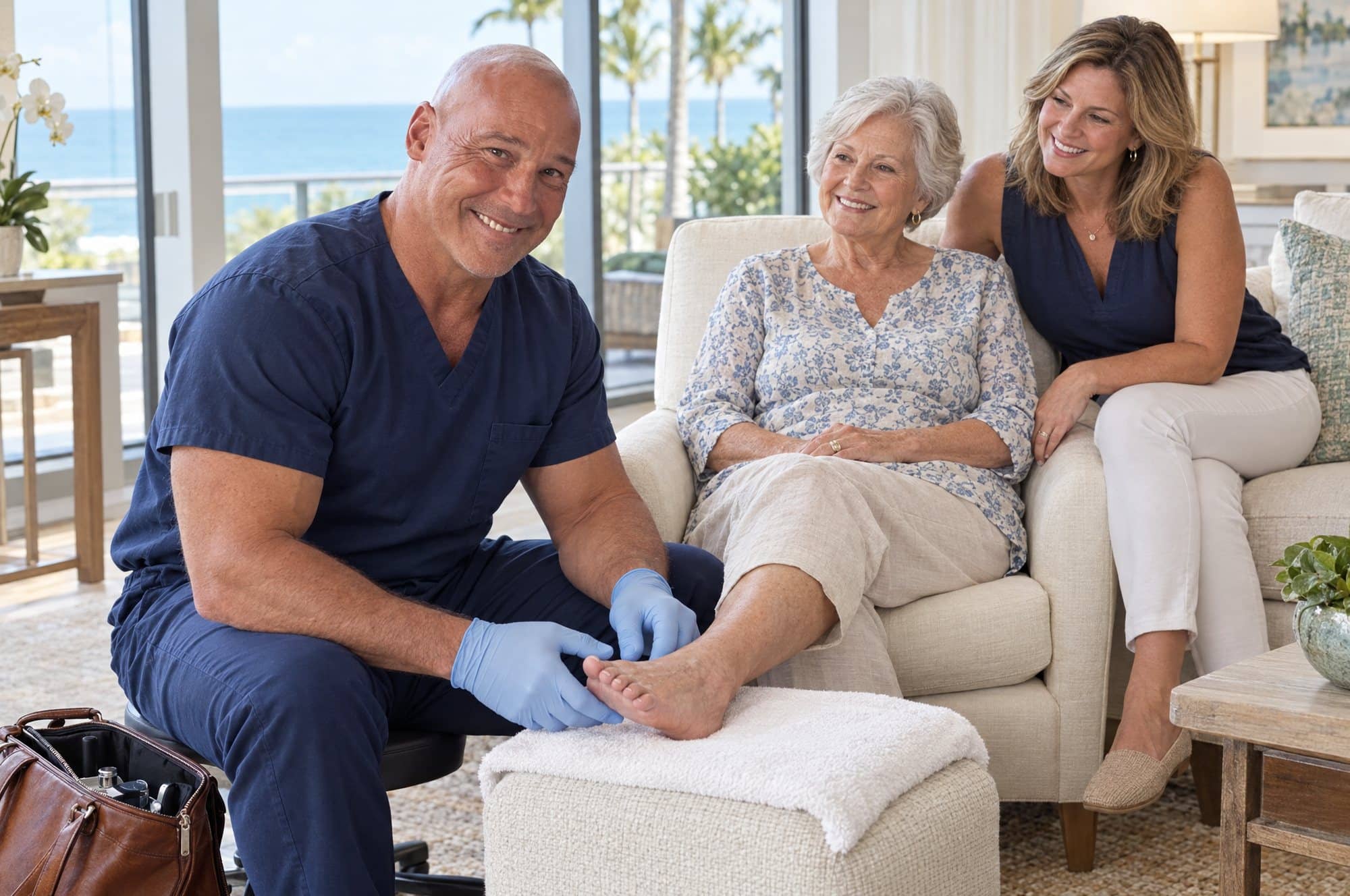
Every visit is documented. With your permission, I'm happy to update a son, daughter or caregiver who couldn't be there.
How long does a visit take?
I don't run house calls on a stopwatch. Visits are unhurried: there's time to look closely, treat carefully and answer every question. A first visit includes your full health history and medication review, so plan on a little extra time. If you need to be somewhere afterward, just tell us when you book.
After the visit: follow-up schedules
How often you'll need a visit depends on why you're being seen:
- Nail and callus care is usually scheduled at regular intervals, based on how fast your nails grow, how thick they are and your overall health.
- Diabetic foot checks. The CDC recommends a complete exam by a foot doctor every year, and more often if you have nerve damage. Medicare covers (opens in a new tab) a foot exam and treatment every six months for people with diabetic nerve damage and loss of protective sensation, as long as you haven't seen a foot care professional for another reason in between.
- A specific problem — an ingrown nail, a sore spot, heel pain — gets a follow-up that fits the problem.
Coverage rules can shape the schedule too. Some foot care is covered only under certain conditions, so we plan visits that fit both your feet and your plan.
Clean, sterile care in your living room
It's fair to wonder how clean a medical visit can be outside an office. The answer: just as clean, when the right steps are followed.
The CDC's infection-control guidance (opens in a new tab) sorts medical instruments by how they're used. Anything that enters tissue or the bloodstream is a "critical" item and must be sterile. Items that touch broken skin need a very high level of disinfection. Items that only touch intact skin need cleaning and disinfection.
Podiatry tools such as nail nippers and the blades used to care for calluses can nick the skin, so they should be sterile for each patient. That's why I bring sterile instruments to every visit.
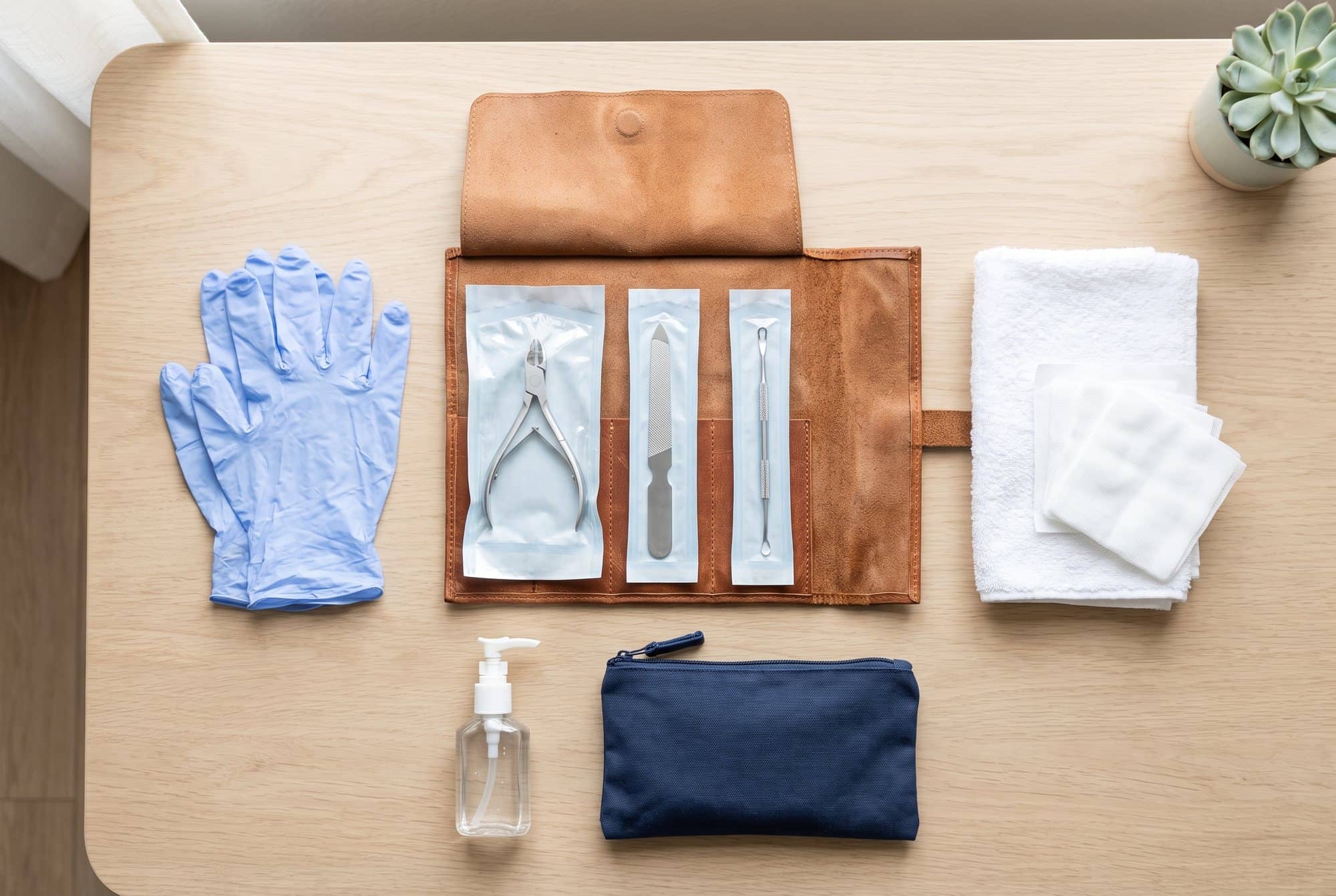
Here's what clean care should look like at any house call:
- Clean hands, and fresh gloves for every patient
- Instruments that come out of sealed, sterilized packaging
- Single-use supplies that are used once and thrown away
- A clean barrier, such as a fresh towel or pad, under your foot
- Used sharp items packed away safely before the doctor leaves
Tip
It's always okay to ask any podiatrist — at your home or in an office — how instruments are cleaned and sterilized between patients. A clear, straightforward answer is a good sign.
Keeping your feet healthy between visits
The habits that keep feet healthy are simple. NIDDK's foot care advice for people with diabetes includes:
- Washing your feet every day in warm, not hot, water. Test it with your elbow or a thermometer; 90 to 95°F is safe. Don't soak your feet, which can dry out the skin.
- Drying well, especially between the toes.
- Rubbing a thin coat of lotion on the tops and bottoms of your feet, but not between the toes.
- Wearing shoes at the beach and on hot pavement, and putting sunscreen on the tops of your feet — advice that fits Naples life well.
- Checking your feet every day, using a mirror or a family member's help if bending is hard.
Cost, Medicare and insurance for house calls
Here's the part everyone wonders about. The short version: I work with Medicare, Medicaid, Aetna, Cigna, Humana and UnitedHealthcare, and more plans are being added. Don't see yours? Just ask. Before your visit, we check your benefits, so you'll know what's covered (and any cost) ahead of time. You can see the plans on the home page under insurance.
What's covered depends on your plan and your health. Here's how the main pieces fit together.
Original Medicare (Part B)
Medicare Part B covers (opens in a new tab) podiatrist foot exams and treatment when you need medically necessary care for foot injuries or diseases, like hammertoes, bunion deformities and heel spurs. After the yearly Part B deductible ($283 in 2026), you generally pay 20% of the Medicare-approved amount.
Routine foot care is different. Medicare usually doesn't cover trimming nails, cutting or removing corns and calluses, or cleaning and soaking the feet — unless a qualifying condition, such as diabetes with nerve damage or poor circulation, makes that care medically necessary. The full rules, including the "class findings" podiatrists document, are in my companion guide: Does Medicare cover podiatry?
Do you have to be homebound?
No. Medicare's billing rules for a doctor's home visit say the patient doesn't need to be confined to the home (CMS Claims Processing Manual, Chapter 12 (opens in a new tab)). The homebound requirement belongs to a different benefit: home health agency care. Whether a particular visit is covered still depends on medical need and on your plan, which is exactly what we check ahead of time.
Medicare Advantage plans
Medicare Advantage plans, including those from companies such as Aetna, Cigna, Humana and UnitedHealthcare, must cover all the medically necessary services Original Medicare covers, and some add extras. They can also have networks, referral rules and prior approval for certain services. Because each company offers many different plans, we confirm your specific plan before the visit.
Good to know
If you split the year between Naples and another state, the type of Medicare you have matters. Original Medicare (opens in a new tab) works with any doctor who takes Medicare, anywhere in the U.S. A Medicare Advantage plan may require you to use providers in its network and service area for non-emergency care. If your plan is based up north, tell us when you book and we'll check before the visit.
Florida Medicaid
According to Florida's Agency for Health Care Administration (opens in a new tab), Florida Medicaid covers medically necessary podiatry services, including foot and nail care, for eligible recipients. If you have both Medicare and Medicaid, Medicare pays first.
If something isn't covered
Sometimes a service won't be covered. Routine nail trimming without a qualifying condition is a common example. If that's likely, you'll know before the visit, so you can decide what you'd like to do. With Original Medicare, you may be given a form called an Advance Beneficiary Notice (ABN), which explains what may not be covered and the estimated cost. My Medicare guide walks through how an ABN works.
House calls in Naples
Rather have Dr. Losier take a look?
He comes to your home with sterile instruments and everything needed for the visit. We’ll check your benefits before your visit, so you’ll know what’s covered (and any cost) ahead of time.
Home visit vs. office visit: an honest comparison
Both are good options. The right choice depends on what you need that day. Here's a side-by-side look.
| Home visit | Office visit | |
|---|---|---|
| Getting there | No driving, parking or waiting room | Travel, parking and check-in |
| Time with the doctor | Unhurried and one-on-one | Varies by practice and schedule |
| Family involvement | Easy to join in person or by phone | Possible, with more planning |
| Your shoes and surroundings | I see the shoes you really wear and how you move at home | Usually limited to the shoes you wore that day |
| Equipment | Sterile instruments and supplies for everyday podiatry | Many offices add on-site X-ray and procedure rooms |
| A good fit for | Nail, callus and diabetic foot care, checkups and limited mobility | Imaging, surgery and more complex procedures |
| Insurance | Depends on your plan; benefits checked before the visit | Depends on your plan |
If you're not sure which you need, describe the problem when you call. If an office or imaging visit makes more sense, I'll tell you.
Questions to ask any house call podiatrist
Whether you call me or someone else, these questions help you choose with confidence:
- Are you a licensed podiatric physician in Florida? You can check any Florida health care license on the Florida Department of Health's license verification site (opens in a new tab).
- What can you treat at home, and what would need an office or imaging?
- How are your instruments cleaned and sterilized between patients?
- Which insurance plans do you work with, and will you check my benefits before the visit?
- Will I see the same doctor every time?
- How do you work with my primary care doctor?
- Can my family join the visit or receive updates?
- What should I do if a problem comes up between visits?
- Do you visit my community? Think gated communities, condo buildings, and independent or assisted living.
For the record, here are my answers to the first few. My Florida license is PO4659, and you can verify it online. I bring sterile instruments to every visit. I work with Medicare, Medicaid, Aetna, Cigna, Humana and UnitedHealthcare, and we check your benefits before your visit. You'll see the same doctor every time — me. And family is always welcome.
Families, condos and assisted living: coordinating care
Good foot care is often a team effort. Here's how to make it work, whether you live down the street or a thousand miles away.
For sons, daughters and caregivers
- Book on their behalf. Call or send a request online. We'll take it from there, gently and on your parent's schedule.
- Join the visit. Be there in person, or join by phone if you can't make it to Naples.
- Share the basics ahead of time. A current medication list, the primary care doctor's name and a short note about any concerns help the visit go smoothly.
- Ask for updates. With your parent's permission, I'm happy to fill you in afterward.
- Keep a simple foot log. Jot down anything new — a sore spot, a change in color, a nail that's bothering them — and bring it to the next visit.
- Include the aide. If a home health aide or companion helps with bathing and dressing, they often notice changes first. Ask them to share what they see, and to be there for the visit if they can.
Caregiver note
Between visits, a quick daily foot check is one of the most useful things you can do. For people with diabetes, NIDDK suggests checking each evening when shoes come off, including between the toes. Look for cuts, sores, red spots, swelling, blisters, ingrown nails, corns, calluses and warm spots. If bending is hard, use a mirror or take a look together.
Condos and gated communities
Many Naples residents live behind a gate or a front desk, and that's no trouble at all with a little notice. When you book, tell us:
- The gate or guard-house instructions, and whose name to give
- Your building, unit number and which entrance to use
- Where to park, including any guest or visitor spaces
- Whether there's an elevator, and who will open the door
Independent and assisted living apartments
I can see you in your own apartment in an independent or assisted living community, and coordinate with the community's staff. For many residents, that's a simple way to keep foot care on schedule.
If you're an administrator, a director of nursing or part of a care team, my Facilities page explains how scheduled on-site rounds work. My article on podiatry services for nursing homes and assisted living covers what residents, families and staff can expect.
The bottom line on in-home podiatry
If foot care has been slipping because getting to appointments is hard, you're not alone — and you don't have to choose between comfortable feet and staying home. A house call podiatrist can handle most everyday foot care in your own chair, with sterile instruments, unhurried time and your family close by.
When something needs an X-ray, a scan or a specialist, you'll hear that plainly too, along with help planning the next step.
Ready to start? Call the office, or send a short request on the contact page. Booking for a parent is just fine. We'll check your benefits before your visit and find a time that works.
This article is general information, not medical advice. For any new or worsening foot problem, contact a podiatrist or your doctor. In an emergency, call 911.
Common questions
No. Many people choose home visits simply for comfort and convenience. Medicare's billing rules for a doctor's home visit don't require you to be confined to your home, though whether a visit is covered still depends on medical need and your plan. We check your benefits before the visit.
Most everyday foot care: trimming and thinning thick or hard-to-cut nails, easing corns and calluses, diabetic foot checks, sore ingrown nail edges, skin checks and footwear advice. If you need an X-ray, a scan or surgery, Dr. Losier will explain why and help you plan the next step.
Long enough to do it properly. Visits are unhurried, with time to look closely, treat carefully and answer every question. A first visit includes a review of your health history and medications, so plan on a little extra time.
Medicare Part B covers medically necessary podiatry. Routine care such as nail trimming is usually covered only when a qualifying condition, like diabetes with nerve or circulation damage, affects your feet. Coverage depends on your plan, so we verify your benefits before the visit.
Yes. Dr. Losier can see residents in their own apartments in independent and assisted living communities and coordinate with the community's staff. Communities interested in scheduled on-site rounds can learn more on the Facilities page.
Yes. Many Naples residents live behind a gate or a front desk. When you book, share the gate or guard-house instructions, your building and unit, where to park and who will open the door.
Yes, seasonal residents are welcome. Original Medicare works with providers who take Medicare anywhere in the U.S., while a Medicare Advantage plan may limit non-emergency care to its network and service area. Tell us your plan when you book and we'll check before the visit.
It depends on why you're being seen. Nail and callus care is usually scheduled at regular intervals based on how fast your nails grow and your health, while the CDC advises a complete diabetic foot exam every year, or more often with nerve damage. Dr. Losier will suggest a schedule that fits your feet and your coverage.
Don’t see your question? Call (914) 844-8024 — a real person will help.
Sources
The health, safety and coverage facts in this article are based on these sources.
- American Podiatric Medical Association — What is a podiatrist?apma.org(opens in a new tab)
- NIDDK (NIH) — Diabetes & Foot Problemsniddk.nih.gov(opens in a new tab)
- CDC — Your Feet and Diabetescdc.gov(opens in a new tab)
- National Institute on Aging — Falls and Fractures in Older Adults: Causes and Preventionnia.nih.gov(opens in a new tab)
- CDC — A Rational Approach to Disinfection and Sterilizationcdc.gov(opens in a new tab)
- Medicare.gov — Foot caremedicare.gov(opens in a new tab)
- Medicare.gov — Foot care (for diabetes)medicare.gov(opens in a new tab)
- CMS — Medicare Claims Processing Manual, Chapter 12 (§30.6.14.1, Home or Residence Services)cms.gov(opens in a new tab)
- Medicare.gov — Compare Original Medicare & Medicare Advantagemedicare.gov(opens in a new tab)
- Florida Agency for Health Care Administration — Podiatry Services (Florida Medicaid)ahca.myflorida.com(opens in a new tab)
About the author
Robert Losier, DPM
Doctor of Podiatric Medicine · Practicing since 2002
Dr. Robert Losier is a Florida-licensed podiatric physician who brings unhurried foot care to patients’ homes across Naples and Southwest Florida, and on-site podiatry to care communities. A graduate of the New York College of Podiatric Medicine, he lives what he teaches — daily movement, strength training and real food — and shares practical healthy-living guidance as part of foot care.
This article is general information, not medical advice. It isn’t a substitute for an exam or for advice from your own doctor or podiatrist about your situation. Please don’t start, stop or change any medication or treatment without talking to the clinician who prescribed it. If you notice a new wound, signs of infection, or a sudden change in the color, temperature or feeling of your foot — especially if you have diabetes — contact your doctor promptly. In an emergency, call 911.