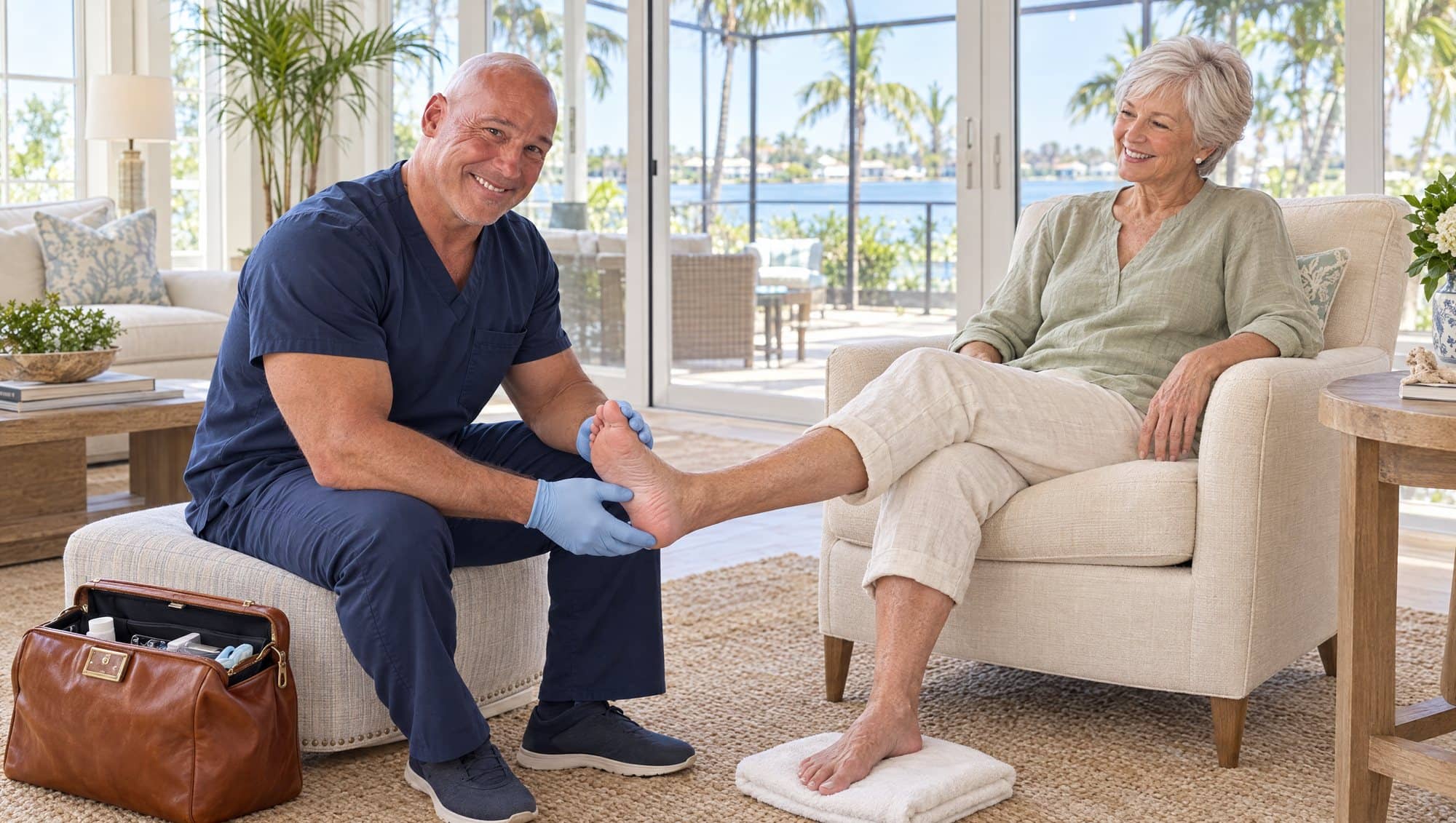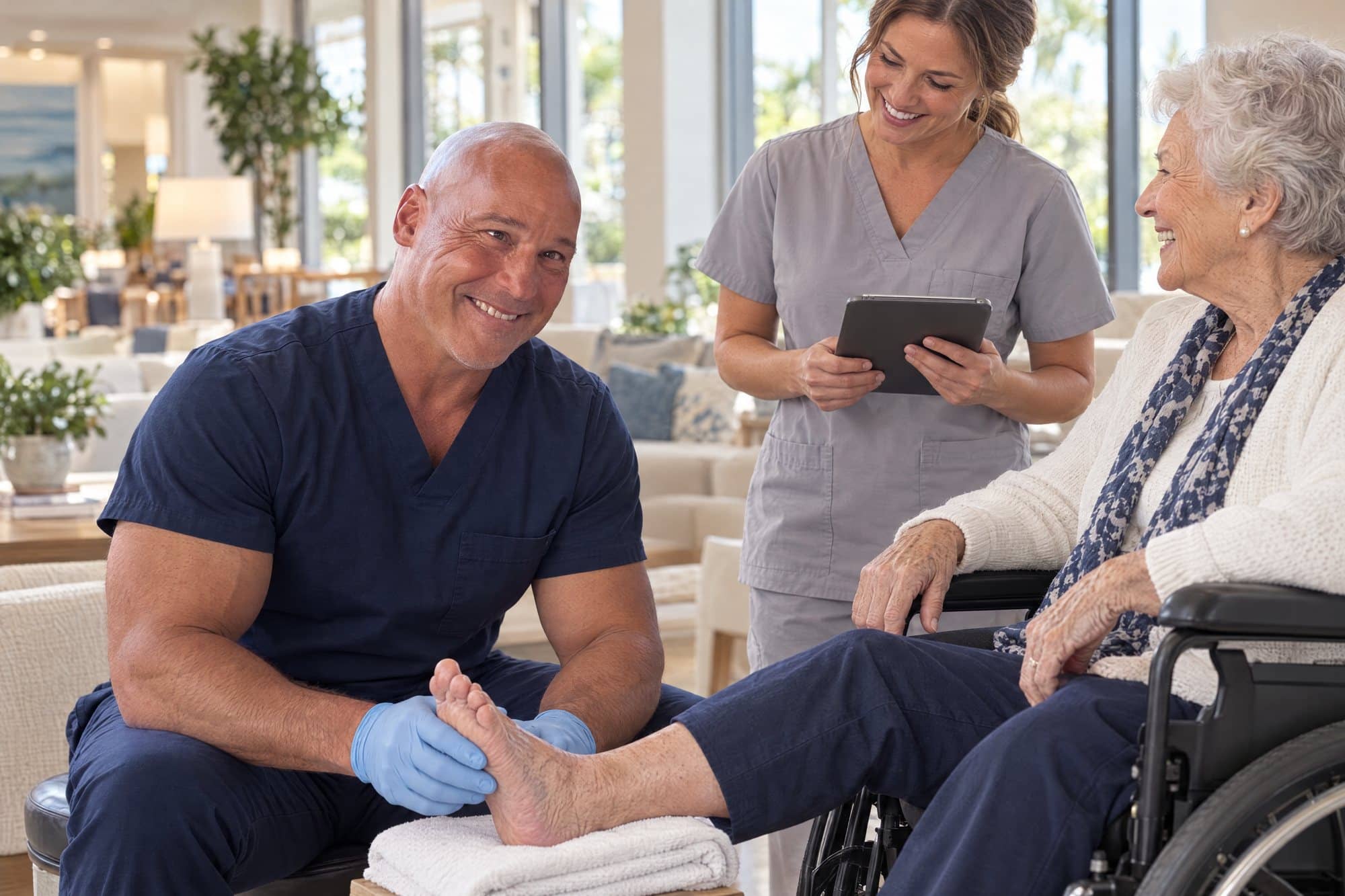
If you run a nursing home or an assisted living community, foot care is easy to overlook — until it isn’t. Thickened toenails start catching on socks. A painful callus quietly keeps a resident from walking to the dining room. A blister goes unnoticed for days on the foot of a resident with diabetes. And surveyors notice, too: federal guidance tells them to look at residents’ feet.
Well-run podiatry services for nursing homes and assisted living close those gaps before they become problems. I’m Dr. Robert Losier, a Florida-licensed podiatrist practicing since 2002. Along with house calls, I make on-site rounds for care communities in Naples and Southwest Florida, and I’m experienced with 40–50 residents in a single visit.
This guide is written for administrators, executive directors, directors of nursing and care coordinators. It explains the rules in plain English and shows what a well-organized podiatry program looks like, from the first intro call to the numbers you can track.
Podiatry services for nursing homes are scheduled, on-site foot care visits by a licensed podiatrist (DPM). They typically include routine and medically necessary nail and skin care, diabetic foot exams, footwear and fall-risk checks, and visit notes for each resident’s chart, helping a facility meet federal foot care requirements without sending residents out for appointments.
Key takeaways
- Federal rules (42 CFR 483.25(b)(2), surveyed as F687) require nursing homes to provide foot care to professional standards and to help residents reach qualified providers such as podiatrists.
- CMS guidance lets trained staff clip nails for residents without complicating conditions, but residents with conditions such as diabetes or poor circulation must be referred to qualified professionals.
- On-site rounds remove the transport barrier: one familiar doctor, a planned resident list and visit notes that reach the chart.
- Foot pain and unsafe footwear are recognized fall risks, so podiatry belongs in your falls program and your post-fall huddles.
- Good preparation — consents, insurance details, a prioritized list and a quiet space — helps a full round of 40–50 residents run calmly and in order.
- Covered services are billed to each resident’s own insurance; coverage depends on the plan and the documentation, so benefits are checked and consent obtained first.
- In Florida assisted living, a facility may not require residents to use a particular health care provider, so on-site podiatry is an option residents choose.
In this article· 14 sections
- 1What podiatry services for nursing homes include
- 2The rules in plain English: F687 and 42 CFR 483.25(b)(2)
- 3Assisted living is different: Florida’s ALF rules
- 4How on-site podiatry rounds work
- 5Your round-day prep checklist
- 6Diabetic foot care in long-term care
- 7Resident nail care policies that hold up
- 8Podiatry and fall prevention in your facility
- 9Documentation, communication and escalation
- 10Billing and consent, at a high level
- 11Choosing a podiatry partner: a checklist
- 12Metrics your facility can track
- 13Common questions
- 14Sources
What podiatry services for nursing homes include
A podiatrist is a doctor of podiatric medicine (DPM). The American Podiatric Medical Association (opens in a new tab) describes a podiatrist as a physician and surgeon who treats the foot, ankle and related structures of the leg. In a care community, most of that work is practical, preventive and repeated on a schedule.
Why residents’ feet need regular attention
Feet change with age. Skin tends to get thinner and drier, nails often thicken, and conditions that affect the feet, such as diabetes and poor circulation, become more common. At the same time, many residents can no longer see or reach their own feet because of limited vision, flexibility or balance, and residents living with memory loss may not be able to tell anyone that something hurts.
That combination is why foot problems in care communities are so often found late. A regular, scheduled look by someone trained to spot early changes is the simplest fix.
Nail care, routine and medically necessary
Thick, fungal, curved, ingrown or hard-to-reach toenails are among the most common foot problems in older adults. Left alone, they can press on the skin, rub inside shoes and make walking painful. Residents with diabetes or poor circulation need professional nail care, because a small nick can turn into a wound that heals slowly. My guides to thick toenails and ingrown toenails explain these problems in more detail for families.
Corns, calluses and skin care
Corns and calluses are thickened skin over pressure points. They’re common in residents whose toes have changed shape over the years or whose shoes no longer fit well. Careful trimming and padding can make standing and walking more comfortable, and the podiatrist can suggest footwear changes to ease the pressure. Dry, cracked heels and fungal skin between the toes get attention, too.
Diabetic foot exams
For residents with diabetes, the exam covers skin, nails, sensation and circulation, looking for early signs of trouble. Findings feed directly into the care plan, so aides and nurses know what to watch for between rounds.
Skin, wound and pressure-area checks
Residents who sit or lie down for long stretches can develop pressure injuries on the heels, ankles and toes. The podiatrist flags early skin changes to the nurse and coordinates with your wound care team and the resident’s attending physician rather than working around them.
Footwear and fall-risk review
Shoes that don’t fit, slippers that slide off and swollen feet stuffed into old sneakers all raise fall risk. A footwear review is quick, practical and often one of the most useful parts of a visit.
Documentation and education
Every resident visit should end with a clear note for the chart, plus simple tips your staff and residents’ families can use between rounds.
| Service | Residents who benefit most | What your team receives |
|---|---|---|
| Nail care | Thick, fungal, ingrown or hard-to-reach nails; residents with diabetes or poor circulation | A visit note with findings, treatment and the next visit |
| Corn and callus care | Painful pressure spots that change how a resident walks | A note plus footwear or padding recommendations |
| Diabetic foot exam | Every resident with diabetes | Skin, sensation and circulation findings, and a follow-up plan |
| Skin and pressure-area check | Residents who sit or lie for long periods; fragile skin | Concerns flagged to the nurse and the care plan |
| Footwear and fall-risk review | Residents with falls, an unsteady gait, swelling or new shoes | Specific footwear advice and input for the falls care plan |
| Staff and family education | Aides, nurses and families | Simple between-round foot care tips |
The rules in plain English: F687 and 42 CFR 483.25(b)(2)
Nursing homes that participate in Medicare or Medicaid must meet the federal requirements in 42 CFR Part 483. Foot care sits in the “Quality of care” section, at 42 CFR 483.25(b)(2) (opens in a new tab) of the regulations. In short, to help residents maintain mobility and good foot health, the facility must:
- Provide foot care and treatment in line with professional standards of practice, including care to prevent complications from a resident’s medical conditions.
- If necessary, help the resident make appointments with a qualified person and arrange transportation to and from those appointments.
Surveyors evaluate this requirement under tag F687, using the interpretive guidance in Appendix PP (opens in a new tab) of the CMS State Operations Manual.
What the CMS guidance says
The guidance is more specific than the regulation, and it’s worth reading in full. The highlights:
- The intent is foot care consistent with professional standards, including treatment to prevent complications from conditions such as diabetes, peripheral vascular disease (poor circulation in the legs) and immobility.
- Preventive care counts. Treatment includes preventive care to avoid foot complications in residents with diabetes and circulatory disorders.
- Staff may clip some nails. Nail clipping for residents without complicating disease processes should be done by staff who have received education and training.
- Some residents must be referred. Residents with complicating disease processes must be referred to qualified professionals, such as a podiatrist, a doctor of medicine or a doctor of osteopathy.
- Access is the facility’s job. The facility is responsible for giving residents access to qualified professionals, including making appointments and arranging transportation.
- Common foot disorders that may need treatment include corns, neuromas (pinched nerves), calluses, bunions, hammertoes, heel spurs and nail disorders.
Infection control is part of foot care
F687 also addresses equipment. Staff must follow infection prevention practices for nail clippers, scalers, files and burr tools, and keep used equipment separate from clean equipment. Reusable devices used on one resident must be cleaned and then disinfected or sterilized, following the manufacturer’s instructions, before use on another resident. If the manufacturer doesn’t provide instructions, the device may not be suitable for use on more than one person.
The infection control guidance (F880) classifies podiatry equipment as “semi-critical,” meaning it requires meticulous cleaning followed by high-level disinfection.
Good to know
For this guidance, CMS counts podiatrists, consultants and contractors as “staff.” Your podiatry partner’s infection-prevention habits are part of your survey picture, so ask exactly how instruments are cleaned, sterilized and stored.
What surveyors look for
The F687 survey probes, paraphrased, give you a ready-made self-check:
- Does the medical record show a condition that puts foot health at risk, such as diabetes, peripheral vascular disease or ingrown toenails?
- Does the comprehensive care plan address that risk with appropriate interventions?
- On observation, do residents’ feet show a lack of nail care, calluses or other foot problems?
- Are residents with foot concerns seen by a qualified foot care specialist, in the facility or in the community?
- Do residents with mobility concerns have foot problems, and has the facility addressed them?
- What preventive foot care do staff provide, and for which residents?
- Is foot care provided when needed and ordered?
- Do staff keep clean and contaminated podiatry equipment separate?
Related tags worth knowing
- F689 (accidents): the guidance lists unsafe or absent footwear among the factors that can contribute to falls.
- F686 (pressure ulcers and injuries): the guidance mentions pressure on the foot from ill-fitting shoes that cause blistering.
- F880 (infection prevention and control): covers the cleaning and disinfection of foot care equipment.
Assisted living is different: Florida’s ALF rules
The federal requirements above apply to nursing homes certified by Medicare or Medicaid, not to assisted living. In Florida, assisted living facilities (ALFs) are licensed under Chapter 429 of the Florida Statutes and Chapter 59A-36 of the Florida Administrative Code. Foot care shows up there in a few practical ways.
Under Florida’s resident care standards (opens in a new tab) (Rule 59A-36.007), to help residents get health care as needed, an ALF must:
- Help residents make appointments, and remind them about scheduled appointments, for medical, dental, nursing or mental health services.
- Provide transportation to those services, or arrange it through family, friends, volunteers, taxis, public buses or transportation agencies.
- Not require residents to receive services from a particular health care provider.
That last point shapes how podiatry works in assisted living. On-site rounds are a convenience residents and families can choose, and some residents will keep seeing their own podiatrist. A clear sign-up process, consent and family communication matter even more here.
Florida’s rules also list nail care as part of grooming help with activities of daily living (Rule 59A-36.002). And when a resident has a significant change, the facility must contact the resident’s health care provider and an appropriate family member or representative. A new foot wound or a sudden change in how someone walks can be exactly that kind of change.

Good to know
Grooming help can include nail care, but residents with diabetes or poor circulation are safer with a podiatrist. The CDC advises people with diabetes to have a podiatrist trim their toenails if they can’t see or reach their feet.
Memory care considerations
Residents living with dementia may find foot care confusing or frightening. A few habits help every visit go more smoothly:
- A familiar aide or nurse stays with the resident and makes the introduction.
- The podiatrist explains each step in simple words before touching the foot.
- Visits happen at the time of day when the resident is usually most settled.
- If a resident becomes distressed, the visit pauses and resumes later or on the next round.
Residents have the right to refuse treatment, under federal rules for nursing homes and as a matter of good care everywhere. A refusal should be documented, respected and offered again at a better moment.
How on-site podiatry rounds work
On-site rounds turn foot care from a series of outside appointments into a planned routine. Residents skip the stress of transport, staff skip the scheduling scramble, and the same doctor gets to know your residents over time. Here’s how it usually unfolds.
Step 1: The intro call
The first conversation is with your administrator or director of nursing (DON). We talk through your census, your resident mix, how foot care is handled today, how consent and billing will work, and how visit notes should reach the chart. By the end of the call, you should have a clear picture of the process before the first round is scheduled.
Step 2: Building the first list
Your DON or unit managers identify residents who would benefit, typically including:
- Residents with diabetes, peripheral vascular disease or neuropathy (nerve damage)
- Thick, fungal, ingrown or painful nails
- Corns, calluses or skin changes on the feet
- Recent falls or an unsteady gait
- New admissions and residents returning from the hospital
- Family requests
Consents and insurance information are gathered for each resident, and benefits are checked before the visit.
Step 3: Round day
| Stage | What happens | Who’s involved |
|---|---|---|
| Check-in | Updates since the last round: admissions, hospital returns, falls, skin concerns | Podiatrist and charge nurse |
| Priority visits | Residents with new or urgent concerns are seen first | Podiatrist, nurse |
| Scheduled visits | Exam, treatment, footwear check and a plain-English explanation for each resident | Podiatrist, with an aide nearby as needed |
| Wrap-up huddle | Findings that need follow-up, recommendations, refusals and the next date | Podiatrist and DON or charge nurse |
Visits happen in the resident’s room or in a quiet treatment space with good light. A typical visit includes a quick check of anything new in the resident’s health, an exam of both feet, treatment, a look at the resident’s shoes and a few words about what comes next. Even on a full round, the pace stays calm and unhurried at the bedside.
What residents experience
For residents, a good visit should feel unhurried and respectful. When I make rounds, I introduce myself, explain what I’m going to do and ask before I touch anyone’s feet. Feet rest on a towel at a comfortable height. Thick nails are trimmed and smoothed, painful corns and calluses are gently reduced, and the resident’s shoes get a quick look. There’s time for questions, and each resident hears in plain words what was done and when they’ll be seen again.
Some residents have lived with foot discomfort for so long that they no longer mention it. A familiar doctor who returns on a regular schedule makes it easier for them to speak up — and easier for your staff to notice when something changes.
Step 4: After the round
Visit notes reach the chart in the format and timeframe agreed during onboarding. Recommendations — footwear changes, padding, referrals or a sooner return visit — go to the nurse responsible for the care plan. Concerns that come up between rounds go straight to the podiatrist, and a visit is coordinated as quickly as the schedule allows.
Scheduling around your census
There’s no single federal schedule for podiatry visits; frequency should follow each resident’s needs and care plan. The CDC advises (opens in a new tab) people with diabetes to see a foot doctor every year for a complete exam, and more often if they have nerve damage. Medicare covers diabetes-related foot exams or treatment (opens in a new tab) every six months for eligible people with diabetic peripheral neuropathy and loss of protective sensation, as long as they haven’t seen a foot care professional for another reason in between.
In practice, a recurring round set with the DON works well, with the list adjusted each time for new admissions, hospital returns and new concerns.
Who does what
| Role | Before the round | During the round | After the round |
|---|---|---|---|
| Administrator or executive director | Agreement, space and policies in place | Available for questions | Reviews program metrics |
| Director of nursing | Resident list, priorities and consent process | Point person and wrap-up huddle | Care plan updates and follow-up |
| Charge or unit nurse | Updates on new concerns and orders | Introduces residents and shares concerns | Receives notes and acts on recommendations |
| Nursing assistants | Residents ready in clean socks, shoes nearby | Help with positioning and comfort | Daily foot observations at bathing and dressing |
| Business office | Insurance details for benefits verification | — | Billing questions |
| Social services or family liaison | Consents with residents and representatives | — | Family updates, per your policy |
| Podiatrist | Reviews the list and history | Exams, treatment and education | Visit notes and recommendations |

For care communities
Bring podiatry on site for your residents.
Scheduled rounds, clear documentation for your nursing team, and a doctor experienced with 40–50 residents per visit.
Your round-day prep checklist
A little preparation is what lets a full round run smoothly. Here’s a checklist your DON can adapt.
Two weeks before
- Confirm the date and arrival time with the podiatrist.
- Build the resident list and flag priorities: diabetes, poor circulation, wounds, recent falls and painful nails.
- Collect signed consents from new residents or their legal representatives.
- Share insurance details so benefits can be checked before the visit.
- Note relevant orders, allergies and medicine lists, including blood thinners.
The day before
- Reserve a quiet room, or confirm which residents will be seen in their rooms.
- Assign a nurse or aide as the point person for the round.
- Let residents and families know the podiatrist is coming. In memory care, explain again on the day.
On the day
- Residents in clean socks, with their everyday shoes nearby for a footwear check.
- Good lighting, a chair with a footrest or a bed at a comfortable height, and towels.
- Hand hygiene supplies and a waste receptacle close by.
- Chart or EHR access, following the process agreed at onboarding.
After
- Visit notes received and filed.
- Care plans updated with new recommendations.
- Follow-ups scheduled and families updated, per your policy.
Diabetic foot care in long-term care
Diabetes deserves its own section, because foot problems in residents with diabetes can become serious quickly. The CDC (opens in a new tab) notes that about half of all people with diabetes have some kind of nerve damage, and that nerves in the feet and legs are affected most often. A resident who can’t feel a pebble in a shoe or a blister on a toe may not complain until there’s a wound.
Nerve damage and poor blood flow raise the risk of foot ulcers, and an ulcer can become infected and heal poorly. If an infection doesn’t respond to treatment, part of the foot or leg may need to be amputated. The CDC also notes that early treatment greatly lowers that risk — which is exactly what a good facility routine is designed to deliver.
Daily habits for your team
The CDC’s diabetic foot care tips translate easily into long-term care routines:
- Look every day. Aides already see residents’ feet at bathing and dressing. Make a quick check of the tops, bottoms and the skin between the toes part of the routine, and report changes.
- Wash and dry well. Use warm, not hot, water, don’t soak the feet, and dry completely, especially between the toes.
- Moisturize, but not between the toes. Lotion on the tops and bottoms helps dry skin; lotion between the toes can lead to infection.
- Never barefoot. Residents should wear shoes and socks or slippers, even indoors, and shoes should be checked for objects inside.
- Leave corns and calluses to the professionals. No cutting, and no over-the-counter removers, which can burn the skin.
- Professional nail care for residents who can’t safely trim their own nails.
When to call the physician or podiatrist
The CDC lists symptoms that shouldn’t wait for the next appointment, including a blister, sore, ulcer, infected corn or ingrown toenail; tingling, burning or pain in the feet; loss of feeling; a change in the color or temperature of the feet; a change in foot shape; and leg pain or cramping during activity. Follow your facility’s protocol and notify the attending physician promptly. In an emergency, call 911.
Heels and residents who spend most of the day in bed or a chair
Residents who can’t easily change position put steady pressure on their heels, ankles and the outer edges of their feet. CMS’s pressure injury guidance (F686) even mentions blistering on the foot from ill-fitting shoes. For residents with diabetes or poor circulation, these spots deserve a look at every skin check.
Report any area that stays red after pressure is relieved, any blister and any dark or broken skin. Coordinate positioning and heel protection with your wound care team and the resident’s physician, and make sure shoes and slippers fit without squeezing swollen feet.
My diabetic foot care guide is written for residents’ families and covers the same warning signs in more detail. It’s a good link to share in admission packets.
Resident nail care policies that hold up
A clear nail care policy protects residents and staff. It answers a simple question for every resident: who should trim these nails, and how?
Start with the CMS guidance. Trained staff may clip nails for residents without complicating conditions. Residents with complicating conditions, such as diabetes or peripheral vascular disease, must be referred to a qualified professional. All of it must follow professional standards and Florida’s scope-of-practice rules.
| Situation | Who usually provides nail care |
|---|---|
| No complicating conditions; healthy nails | Trained staff, following your policy |
| Diabetes, poor circulation or other complicating conditions | A qualified professional, such as a podiatrist |
| Thick, fungal, ingrown or painful nails | A podiatrist |
| Signs of infection, open skin or bleeding | The nurse notifies the physician or podiatrist promptly |
What a solid policy covers
- Screening at admission: identify foot risks such as diabetes, circulation problems, neuropathy and past ulcers or amputations.
- Care planning: document foot risks and interventions in the comprehensive care plan.
- Who may trim: define which staff may clip nails, what training they need, and which residents are excluded.
- Equipment: assign resident-specific tools or reprocess shared tools following the manufacturer’s instructions, and keep clean and used equipment apart.
- Documentation: record nail care, findings and referrals.
- Refusals: document the refusal, try again at another time and let the nurse know.
- Escalation: spell out which findings go to the nurse, the podiatrist or the physician, and how fast.
Training topics for nursing assistants
Nursing assistants see residents’ feet more often than anyone else on the team. A short in-service, refreshed regularly, can cover:
- What a healthy foot looks like, and what to report: redness, blisters, sores, swelling, drainage, a color change or a new odor
- Which residents are on the podiatrist’s nail list, and why
- Washing, drying and moisturizing the feet, never between the toes
- Putting on socks and shoes so they don’t wrinkle, rub or slide
- Cleaning and storing nail care tools, and keeping clean and used equipment apart
- How to document foot observations and refusals
I’m glad to share simple teaching points like these with your team during rounds.
The same logic works in assisted living, where Florida’s rules treat nail care as grooming help. A resident with diabetes or poor circulation should be on the podiatrist’s list, not the grooming schedule.
Podiatry and fall prevention in your facility
Falls are common in long-term care, and they’re a major safety concern. According to the Agency for Healthcare Research and Quality (opens in a new tab) (AHRQ), about half of the 1.6 million residents of U.S. nursing facilities fall each year, and about one in three of those who fall will fall two or more times in a year.
Feet are part of that picture. The CDC (opens in a new tab) lists foot pain or poor footwear among the fall risk factors that can be changed, alongside lower body weakness, walking and balance problems, certain medicines and vision problems. The CMS guidance for F689 lists unsafe or absent footwear among the factors that can contribute to falls. And AHRQ’s Falls Management Program calls for assessing the resident’s footwear and foot care after a fall, and names safe footwear and good lighting at night as crucial.
What podiatry adds to a falls program
- Less pain, more walking. Painful nails, corns and calluses change how residents walk, or keep them from walking at all.
- Sensation and circulation checks. Numb feet send less information to the brain about where the floor is.
- Footwear that fits. Swelling, toe deformities and worn-out shoes all affect fit. The podiatrist can recommend specific changes.
- A link to therapy. Footwear and foot findings are useful to your physical and occupational therapists when they work on gait and balance.

A quick footwear check for residents
- A closed back, so the shoe stays on
- A non-slip sole that isn’t worn smooth
- Laces or hook-and-loop straps that are easy to fasten
- Enough room for swollen feet and toe changes, without sliding around
- Worn with socks, and never swapped for socks alone
Add footwear and foot pain to your post-fall huddle, too. AHRQ’s post-fall process includes noting the type of footwear the resident had on. For families, my article on feet, balance and fall prevention offers a home-friendly version of the same ideas.
Documentation, communication and escalation
Good foot care that isn’t documented is hard to prove, hard to follow up and easy to lose at shift change. Agree on documentation before the first round, so notes arrive where your team works.
What a podiatry visit note should include
- The date, the resident and the reason for the visit
- Findings: skin, nails and, when assessed, sensation and circulation
- Treatment provided
- Risk level and any change since the last visit
- Recommendations, such as footwear, padding, referrals or a sooner return
- Consent, or a documented refusal
- When the resident should be seen next

Feeding the care plan
Podiatry recommendations only help if they reach the care plan. Federal rules give nursing home residents the right to participate in developing their person-centered care plan, and to be told in advance about changes to it. Share podiatry findings with the interdisciplinary team, and let residents and their representatives know when a recommendation changes their care.
An escalation pathway
| Finding | Who acts | How quickly |
|---|---|---|
| New blister, sore, ulcer or wound | The nurse notifies the physician and podiatrist per protocol | The same day |
| Redness, warmth, swelling, drainage, or a change in color or temperature | The nurse notifies the attending physician | Promptly; call 911 for emergencies |
| Painful nail, ingrown nail or callus | The nurse requests a visit or adds the resident to the next round | At the next available visit |
| A fall with foot pain or a footwear problem | The falls huddle includes a footwear and foot review | At the huddle; podiatry follow-up as needed |
| A resident or family request | The DON coordinates | At the next round, or sooner if needed |
Communicating with families
Families want to know their loved one’s feet are cared for. Share podiatry updates through your usual channels and within your privacy policies. Invite families to bring well-fitting shoes, and to tell the nurse if they notice limping, a new sore or shoes that suddenly don’t fit. Many will appreciate a link to articles such as thick toenails in older adults.
Billing and consent, at a high level
Billing is where facility leaders understandably want clarity, and it’s where careful language matters. Here’s the general framework. Your business office and the podiatrist will work through the details for your residents.
Each resident’s own insurance
Covered podiatry services are billed to each resident’s own insurance, such as Medicare, Medicaid or a private plan. Medicare.gov (opens in a new tab) explains that Medicare Part B covers foot exams or treatment by a podiatrist when they’re medically necessary for foot injuries or diseases, such as hammertoes, bunions and heel spurs.
Medicare doesn’t usually cover routine foot care — trimming nails, removing corns and calluses, and hygienic care such as cleaning and soaking the feet — on its own. But the Medicare Benefit Policy Manual (opens in a new tab) describes exceptions:
- Systemic conditions: routine-type care may be covered when a condition such as diabetes, peripheral vascular disease or certain neuropathies causes severe circulation problems or reduced sensation in the feet. For some conditions, the resident must be under the active care of a medical doctor or doctor of osteopathy.
- Fungal (mycotic) nails: treatment may be covered when documentation shows the infection and related pain, secondary infection or, for residents who walk, marked limitation of walking.
- Part of other covered care: routine-type services performed as a necessary part of treating ulcers, wounds or infections.
For covered services, the resident generally pays 20% of the Medicare-approved amount after the Part B deductible. Non-covered services are usually the resident’s responsibility. Medicare Advantage, Medicaid and private plans each have their own rules.
Why documentation drives coverage
Medicare’s exceptions depend on what the record shows. The Benefit Policy Manual describes findings that can support coverage of routine-type foot care for people with circulation problems — for example, a nontraumatic amputation of part of the foot; absent pulses at the ankle or on top of the foot; advanced skin, hair and nail changes; or symptoms such as leg cramping with walking, cold feet, swelling, abnormal sensations and burning. Certain combinations of these findings allow coverage to be presumed.
In plain English, the podiatrist’s note has to describe what was actually found, not just what was done. That’s one more reason to agree on documentation before the first round, and to keep each resident’s diagnoses and attending physician information up to date in the chart.
Consent comes first
Federal rules give nursing home residents the right to be informed in advance of the care to be provided and who will provide it, to be told the risks and benefits of proposed treatment, and to request, refuse or discontinue treatment. In practice, that means a signed consent from the resident or legal representative before the first visit, and a clear explanation of what to expect.
Good to know
Dr. Losier works with Medicare, Medicaid, Aetna, Cigna, Humana and UnitedHealthcare, and more plans are being added. Benefits are checked before the visit, so residents and families know what’s covered and any cost ahead of time. Coverage always depends on the plan and the documentation. Read more about insurance, or see does Medicare cover podiatry? for families.
Questions worth raising with your business office include how outside practitioners’ claims are handled for residents in a Medicare Part A skilled stay, and how you want insurance details shared for benefits verification.
Choosing a podiatry partner: a checklist
Whether you’re starting a podiatry program or reviewing the one you have, these questions help you compare options fairly.
- License: Is the podiatrist licensed in Florida? You can verify any license online with the Florida Department of Health.
- Consistency: Will the same doctor come to every round?
- Capacity: Is the podiatrist comfortable with a full round at your census, at a calm pace?
- Infection control: How are instruments cleaned, sterilized, stored and transported? Which items are single-use?
- Documentation: Can you see a sample visit note, with identifying details removed? How soon after a round do notes arrive?
- Consent and benefits: How are consents gathered, and how are benefits checked before the visit?
- Communication: How do you reach the podiatrist between rounds, and how are urgent concerns handled?
- Scope: What is treated on site, and how are referrals to wound care, vascular or surgical specialists coordinated with the attending physician?
- Education: Will the podiatrist share simple foot care guidance with staff and families?
- Insurance: Which plans does the practice work with?
A sample first-month rollout
Every community moves at its own pace, but a first month often looks something like this:
- Week 1: an intro call with the administrator and DON to agree on documentation, consent and how residents are referred.
- Week 2: build the first resident list, flag priorities and start collecting consents.
- Week 3: share insurance details for benefits checks, and confirm the round date and space.
- Week 4: the first round, followed by a short debrief on what worked and what to adjust.
After that, rounds settle into the rhythm you agreed on, and the resident list is refreshed before each one.
How Dr. Losier works with facilities
Dr. Losier is a Florida-licensed podiatric physician with license PO4659, which you can verify online (opens in a new tab) with the Florida Department of Health. He is a 2002 graduate of the New York College of Podiatric Medicine. He has been practicing since 2002 and is experienced with rounds of 40–50 residents in a single visit.
The process is straightforward. It starts with an intro call with your administrator or DON. Together we plan a round schedule around your census and your team’s workflow, and agree on how notes reach the chart. Then comes ongoing care: the same doctor on every round, clear documentation after each visit and easy communication in between. You can learn more on the facilities page, read about Dr. Losier, or get in touch.
For care communities
Bring podiatry on site for your residents.
Scheduled rounds, clear documentation for your nursing team, and a doctor experienced with 40–50 residents per visit.
Metrics your facility can track
You don’t need to guess whether your foot care program is working. Simple process measures, tracked over time, show whether residents are getting the care your policies promise. Start with your own baseline, set realistic targets with your team, and fold the results into your quality assurance and performance improvement (QAPI) program.
| Metric | How to measure it | Why it matters |
|---|---|---|
| Admission foot-risk screens | Share of new admissions screened within your policy’s timeframe | Finds at-risk residents early |
| At-risk residents seen as planned | Share of residents with diabetes or circulation problems seen on their care-plan schedule | Reflects the core intent of F687 |
| Referral-to-visit time | Days from a nurse’s request to the podiatry visit | Shows responsiveness between rounds |
| Nail care documentation | Share of residents with current nail care status in the chart | Supports survey readiness |
| Footwear checked after falls | Share of post-fall huddles that record footwear and foot pain | Follows AHRQ’s post-fall guidance |
| Escalations | Foot concerns escalated, and time to physician notification | Tests your escalation pathway |
| Refusals and re-offers | Refusals documented and visits offered again | Respects resident rights and keeps follow-up on track |
| Staff training | Share of staff trained in nail care and equipment cleaning | Supports infection control |
| Survey findings | Citations related to F687, F689 or F880 per survey cycle | The big-picture check |
These are measures of what your team does, not promises about outcomes. Tracked honestly, they show where the program is strong and where it needs attention.
Foot care rarely makes headlines in a care community, but residents feel it in every step. A planned program — clear policies, a familiar podiatrist, good notes and a few honest measures — keeps it from slipping through the cracks.
This article is general information, not medical, legal or billing advice. Regulations and payer policies change, so confirm current federal and Florida requirements with your compliance and billing teams. In an emergency, call 911.
Common questions
Federal rules require nursing homes to provide foot care and treatment that meets professional standards, and to help residents make appointments with qualified providers and arrange transportation (42 CFR 483.25(b)(2), surveyed as F687). CMS guidance names podiatrists among those qualified providers. Many facilities meet the need with on-site rounds.
F687 is the CMS survey tag for the nursing home foot care requirement. Surveyors check whether at-risk residents have care-plan interventions, whether nail care and calluses are addressed, whether residents see a qualified foot care provider, and whether foot care equipment is kept clean and separated properly.
CMS guidance allows trained staff to clip nails for residents without complicating conditions. Residents with complicating conditions, such as diabetes or circulation problems, must be referred to a qualified professional such as a podiatrist. Follow your own policies and Florida scope-of-practice rules.
There’s no single federal schedule; it depends on each resident’s needs and care plan. The CDC advises people with diabetes to see a foot doctor at least once a year, and more often with nerve damage. A practical approach is a recurring round, with extra visits for new concerns.
Covered services are billed to each resident’s own insurance, such as Medicare, Medicaid or a private plan. Medicare doesn’t usually cover routine foot care unless specific medical conditions are documented, so benefits are checked and residents or their representatives consent before treatment. Any resident cost is explained ahead of time.
Dr. Losier is experienced with rounds of 40–50 residents in a single visit. The schedule is built around your census and your team’s workflow, and the same doctor comes to every round.
No. Florida’s assisted living rules say a facility may not require residents to receive services from a particular health care provider. On-site podiatry is a convenient option that residents and families can choose.
Care communities in Naples and nearby Southwest Florida, including Marco Island, Bonita Springs and Estero, with other areas by arrangement. A short intro call is the easiest way to talk through your community’s needs.
Don’t see your question? Call (914) 844-8024 — a real person will help.
Sources
The health, safety and coverage facts in this article are based on these sources.
- eCFR — 42 CFR 483.25 Quality of care (paragraph (b)(2), Foot care)ecfr.gov(opens in a new tab)
- CMS — State Operations Manual, Appendix PP: Guidance to Surveyors for Long Term Care Facilities (F687, F689, F880)cms.gov(opens in a new tab)
- eCFR — 42 CFR 483.10 Resident rightsecfr.gov(opens in a new tab)
- Florida Administrative Code 59A-36.007 — Assisted Living Facility Resident Care Standardsflrules.org(opens in a new tab)
- Medicare.gov — Foot care (other)medicare.gov(opens in a new tab)
- CMS — Medicare Benefit Policy Manual, Chapter 15, Section 290: Foot Carecms.gov(opens in a new tab)
- CDC — Your Feet and Diabetescdc.gov(opens in a new tab)
- CDC — Facts About Older Adult Fallscdc.gov(opens in a new tab)
- AHRQ — The Falls Management Program: A Quality Improvement Initiative for Nursing Facilitiesahrq.gov(opens in a new tab)
- American Podiatric Medical Association — What Is a Podiatrist?apma.org(opens in a new tab)
About the author
Robert Losier, DPM
Doctor of Podiatric Medicine · Practicing since 2002
Dr. Robert Losier is a Florida-licensed podiatric physician who brings unhurried foot care to patients’ homes across Naples and Southwest Florida, and on-site podiatry to care communities. A graduate of the New York College of Podiatric Medicine, he lives what he teaches — daily movement, strength training and real food — and shares practical healthy-living guidance as part of foot care.
This article is general information, not medical advice. It isn’t a substitute for an exam or for advice from your own doctor or podiatrist about your situation. Please don’t start, stop or change any medication or treatment without talking to the clinician who prescribed it. If you notice a new wound, signs of infection, or a sudden change in the color, temperature or feeling of your foot — especially if you have diabetes — contact your doctor promptly. In an emergency, call 911.