It usually starts small: a big toe that's a little tender when you pull on a sock. A day or two later your shoe presses on it, the skin beside the nail turns pink and puffy, and suddenly every step is about that one toe.
Ingrown toenails are common, and the right ingrown toenail treatment depends on how far along it is and on your overall health. A mild one in a healthy adult can often be eased at home. One that's infected, or any ingrown nail in someone with diabetes, neuropathy or poor circulation, needs a podiatrist, not a pair of clippers and a steady hand.
When I see an ingrown toenail on a house call, my first questions are about the person, not just the toe. Do you have diabetes? How is your circulation? Can you feel your feet well? This guide follows the same thinking: what's safe at home, what isn't, what a podiatrist actually does, and how to keep it from coming back.
Ingrown toenail treatment depends on how severe it is. A mild ingrown nail in a healthy adult often settles with warm soaks, roomy shoes and time. Signs of infection, or any ingrown nail in someone with diabetes, neuropathy or poor circulation, call for a podiatrist, who can numb the toe and remove the ingrown edge.
Key takeaways
- An ingrown toenail happens when the edge of the nail presses or grows into the skin beside it, most often on the big toe.
- Mild cases in otherwise healthy adults often improve with warm soaks, roomy shoes and letting the nail grow out.
- Never dig out the corner or cut a V in the nail. "Bathroom surgery" can turn a sore toe into an infected one.
- With diabetes, neuropathy, poor circulation or any sign of infection, see a podiatrist promptly instead of treating it yourself.
- A podiatrist can numb the toe and remove just the ingrown edge, and treating the nail root can keep a stubborn edge from coming back.
- Trim toenails straight across, not too short, and choose shoes with plenty of room for your toes.
In this article· 14 sections
- 1What is an ingrown toenail?
- 2Ingrown toenail causes
- 3Mild, moderate or severe: how to tell
- 4Ingrown toenails after 60, and with diabetes
- 5Ingrown toenail treatment at home: what's safe for mild cases
- 6What not to do: why "bathroom surgery" backfires
- 7When to see a podiatrist for an ingrown toenail
- 8Professional ingrown toenail treatment: what to expect
- 9Recovery and recurring ingrown toenails
- 10Preventing ingrown toenails: trimming, shoes and everyday habits
- 11A caregiver's guide to ingrown toenails
- 12How house calls help with ingrown toenails
- 13Common questions
- 14Sources
What is an ingrown toenail?
An ingrown toenail is a nail whose corner or side edge presses into, or grows into, the soft skin along the side of the nail. The American Podiatric Medical Association (APMA) describes the problem as the corner or side of a nail digging painfully into the soft skin along the nail groove, which often brings redness, swelling and irritation. The medical name is onychocryptosis, but "ingrown toenail" says it just as well.
The parts of a toenail, in plain English
A few simple terms make the rest of this guide easier to follow:
- Nail plate: the hard nail you see and trim.
- Nail folds: the soft skin that borders the nail along each side and at its base.
- Nail groove: the narrow channel where the side of the nail tucks under the fold. This is where ingrown edges cause trouble.
- Nail matrix: the nail's "root," the tissue under the skin at the base of the nail that makes new nail. It matters because a podiatrist can treat a small part of it to stop one problem edge from growing back.
- Nail bed: the skin underneath the nail plate.
Why a small spike of nail hurts so much
A review in American Family Physician explains that an ingrown nail injures the skin of the side fold, and the body reacts to the nail edge the way it would to a splinter. That reaction brings redness, swelling and pain. Over time, the area can drain, smell unpleasant and grow extra tissue.
The APMA calls this extra tissue "proud flesh." Doctors call it granulation tissue. It often looks red and shiny, and it's a sign the problem has been going on for a while.
How common are ingrown toenails?
Very common. The American Family Physician review estimates that ingrown nails account for about 20 percent of the foot problems family doctors see, and Cleveland Clinic puts it as two out of every 10 people who visit a provider for a foot issue. The big toe is affected most often.
The same review notes they're most common in young men, but they can happen at any age, and older adults have their own set of risk factors, which we'll get to below.
Ingrown toenail causes
Most ingrown toenails come down to a mix of how the nail is trimmed, what's pressing on the toe, and the natural shape of the nail. Here are the usual causes.
How the nails are trimmed
Trimming is the cause people can most easily change. Cleveland Clinic notes that cutting toenails too short or rounding the corners can let the nail grow into the skin.
A figure in the American Family Physician review puts three common mistakes next to the right way: cutting too short, rounding the edges and cutting a V-shaped notch, compared with cutting straight across. Tearing a nail edge is another cause, according to a separate American Family Physician article, and the APMA advises never tearing the edges of your nails.
Shoes that crowd the toes
Tight shoes press the skin of the toe against the nail edge all day long. The APMA lists tight footwear that crowds the toes as a cause, and the NHS advises against tight, poorly fitting shoes. Narrow, pointed toe boxes are the usual offenders.
Stubs, drops and repeated pressure
An injury can start an ingrown nail. Cleveland Clinic lists toe injuries such as banging your toe or having it stepped on, as well as tearing the corner of the nail. The American Family Physician review adds repeated pressure from activities like running and kicking.
Nail shape and family history
Some people are simply built for it. The APMA lists heredity as a cause, and Cleveland Clinic notes that toe shape plays a role, for example when the nail is large compared with the toe, or when the skin along the edge naturally wraps around the nail.
Sweaty feet, fungus and thick nails
Excess sweating (hyperhidrosis) appears among the risk factors in the American Family Physician articles, and fungal nail infections (onychomycosis) are another factor. The 2019 review lists managing both as part of treatment, and Cleveland Clinic includes people with nail infections among the higher-risk groups.
Swelling, weight and other health conditions
The 2009 American Family Physician article lists obesity among the risk factors, along with conditions that cause swelling in the feet and legs, such as diabetes and thyroid, heart and kidney disorders. Swelling can push the soft skin of the toe up against the nail edge. Poor foot hygiene is on the list too.
Mild, moderate or severe: how to tell
Ingrown toenails tend to move through stages. The 2009 American Family Physician article describes three, and knowing which one you're looking at helps you decide what to do next. The 2019 review notes that nonsurgical care is typically used for mild to moderate cases, while removing part of the nail is preferred for moderate to severe ones.
| Stage | What you may notice | What usually helps |
|---|---|---|
| Mild | Swelling, redness and tenderness along the nail edge, especially when pressed | Home care if you're otherwise healthy; a podiatrist if it isn't improving in a few days |
| Moderate | More swelling, drainage that may look cloudy or like pus, signs of infection, a sore along the nail fold | A podiatrist, who may lift or splint the edge or remove it |
| Severe | Long-lasting inflammation, red and shiny extra tissue, and a thickened, overgrown nail fold | A podiatrist, usually to remove the ingrown edge and often to treat the nail root |
If you have diabetes, neuropathy or poor circulation, skip the first row. Any stage is a reason to call a podiatrist.
Infected ingrown toenail signs
An infection changes the plan. Watch for:
- Pain that's getting worse instead of better.
- Redness, warmth or swelling that's spreading, or skin that looks darker than usual (Cleveland Clinic).
- Pus or cloudy fluid coming from the side of the nail (NHS, Cleveland Clinic).
- A bad smell (APMA).
- Red, shiny, bumpy extra tissue along the nail edge, the "proud flesh" described above (APMA).
- Feeling hot or shivery, or running a fever (NHS).
Cleveland Clinic notes that in rare, long-running cases, an ingrown toenail infection can spread through the toe and into the bone. That's uncommon, but it's one reason not to let an infected toe drag on.
When to call a podiatrist
Call promptly if you see pus, spreading redness, warmth or a bad smell, or if you have diabetes, neuropathy or poor circulation and notice any ingrown nail at all. If redness is spreading up the foot, or you have a fever or chills, get same-day care. In an emergency, call 911.
Ingrown toenails after 60, and with diabetes
Ingrown toenails aren't just a teenager's problem. Later in life, a different set of changes makes them more likely and more important to handle carefully.
Thicker nails are harder to trim
The 2009 American Family Physician article notes that the natural aging process causes toenails to thicken, which makes them harder to cut. It also points out that in older adults, a reduced ability to care for their nails can leave small, sharp spikes of nail at the edges, called spicules, that turn into a chronic problem.
Thick, curved or brittle nails are a common reason older adults need help with nail care. Our guide to thick toenails in older adults covers why nails change and how they can be managed safely.
Reaching, seeing and gripping
Trimming toenails well takes good eyesight, a comfortable reach to your feet and steady hand strength. Any of those can get harder over the years. If trimming has turned into a struggle, that's a good reason to get help rather than rush the job, because rushed trimming is where uneven, too-short corners come from.
The NIDDK, part of the National Institutes of Health, advises having a podiatrist trim your toenails if you can't see, feel or reach your feet, or if your nails are thick or yellowed.
Ingrown toenails and diabetes: don't wait
With diabetes, an ingrown toenail is never just a sore toe. The American Diabetes Association (ADA) explains that nerve damage can lessen your ability to feel pain, so a problem may go unnoticed until the skin breaks down and infection sets in. Poor circulation also reduces your ability to heal.
That's why the APMA advises people with diabetes or circulation problems to avoid treating ingrown nails themselves and to seek care at the first signs. Cleveland Clinic gives similar advice. If you have diabetes, call your podiatrist at the first sign of an ingrown nail, not after a week of soaking.
Daily foot checks matter here. The NIDDK recommends checking your feet every day for cuts, sores, red spots, swelling and other changes. For the bigger picture, see our diabetic foot care guide.
Who should skip home treatment
Please don't treat an ingrown toenail yourself, and call a podiatrist instead, if any of these apply:
- You have diabetes.
- You have numbness, tingling or burning in your feet, which can be signs of neuropathy.
- You have poor circulation, such as peripheral artery disease, or sores on your feet or legs that are slow to heal.
- You've been told your immune system is weakened, or you're prone to infections.
- You see any sign of infection from the list above.
- The nail edge is buried deep in the skin, or the pain is severe.
- You can't comfortably see or reach your feet.
A word about medications
Tell your podiatrist about every medicine you take, including blood thinners. They don't usually rule out treatment, and the 2019 American Family Physician review even notes that one common technique is particularly useful for people taking blood thinners. Your podiatrist will plan around your medications. Never stop or change a medication on your own.
Ingrown toenail treatment at home: what's safe for mild cases
Home care is only for mild ingrown toenails in adults who are otherwise healthy. The aim is simple: calm the inflammation, take the pressure off, and give the nail edge a chance to grow out past the skin. The 2019 review notes that conservative care continues until the nail grows past the edge of the fold, which typically takes two to 12 weeks.
Step 1: Soak the foot in warm water
Soak the foot in warm, soapy water for 10 to 20 minutes, as the American Family Physician review describes. The NHS suggests warm, salty water, and Cleveland Clinic suggests warm water with Epsom salt or soapy water, twice a day.
Test the temperature with your elbow or a thermometer first. Warm is the goal, never hot. Sit down for the whole soak, with the basin on a towel and a non-slip mat underfoot.
Step 2: Dry thoroughly and keep it dry
Pat the foot dry, including between the toes. The NHS advises keeping the foot dry for the rest of the day, and Cleveland Clinic recommends keeping feet dry between soaks.
Step 3: Give your toes room
Wear wide, comfortable shoes or sandals, as the NHS suggests. The American Family Physician review recommends footwear with an open toe or a wide toe box. Leave the narrow dress shoes in the closet until the toe has settled.
Step 4: Keep it clean and covered
A clean, loose bandage protects the toe from rubbing and keeps it clean. Ask your podiatrist or pharmacist before putting creams or ointments on it, especially if the skin is broken.
Step 5: Ease the pain safely
The NHS mentions common over-the-counter pain relievers for an ingrown toenail. Ask your doctor or pharmacist which one is safe for you, since some aren't a good fit with certain health conditions or medicines. Don't start or change a medication without that advice.
Step 6: Let the nail grow out
The NHS advises not to cut the toenail and to leave it to grow out, and not to pick at your toe or toenail. Trimming the corner shorter can feel like relief for a day, but it can leave a sharp edge deeper in the groove, ready to dig in again.
What about cotton or dental floss under the nail?
Some medical sources describe gently placing a small wisp of cotton or dental floss under the ingrown corner to lift it away from the skin. The American Family Physician review notes this can work for mild to moderate cases, and Cleveland Clinic suggests a small piece of cotton changed daily.
Here's where I draw the line for older adults. If the corner is easy to see and only mildly tender, a tiny wisp of clean cotton may help. If you'd have to dig, pry or cut to get under it, stop. That's a job for your podiatrist, who can lift the edge or place a small splint with sterile instruments.

How long should home care take?
Cleveland Clinic notes that soaking often improves symptoms within a few days. If the toe isn't clearly better after two or three days, or it gets worse at any point, stop home care and call a podiatrist.
Mild ingrown toenail: home care checklist
- I don't have diabetes, neuropathy, poor circulation or a weakened immune system
- There's no pus, spreading redness or bad smell
- Warm (tested) soak for 10 to 20 minutes, once or twice a day
- Foot dried well and kept dry between soaks
- Roomy shoes or open-toe sandals
- Clean, loose bandage
- No cutting, digging or picking at the corner
- Clearly better within two or three days, or I'm calling my podiatrist
What not to do: why "bathroom surgery" backfires
"Bathroom surgery" is the nickname for home attempts to cut out an ingrown corner with clippers, scissors or a razor. It's an easy way to turn a mild ingrown nail into an infected one.
Don't dig out the corner
The American Academy of Dermatology (AAD) advises avoiding "digging out" ingrown toenails, especially if they're infected and sore. The APMA also advises against trying to remove infected parts of the nail yourself.
The problem is that the part of the nail causing trouble sits under the skin, where you can't see it. Cutting blindly into the groove can leave a sharp spike behind, cut the skin, and open the door to infection.
The V-notch myth
There's an old idea that cutting a V-shaped notch into the middle of the nail will somehow pull the edges away from the skin. The American Family Physician review lists V-shaped cuts among the improper ways to trim toenails. It doesn't fix an ingrown nail, so skip it and trim straight across.
Don't count on over-the-counter fixes
The APMA advises against relying on over-the-counter medications for an infected ingrown nail and recommends a podiatrist's evaluation instead. If the toe is red, draining or getting worse, a product from the pharmacy shelf isn't the answer.
Antibiotics alone don't fix the cause
It's natural to think an infected toe just needs antibiotics. The 2019 American Family Physician review notes that neither oral nor topical antibiotics before or after treatment improve outcomes, and that oral antibiotics aren't recommended unless there's clear, widespread infection of the surrounding skin (cellulitis). The nail edge is the splinter. Until it's dealt with, the inflammation tends to come back.
Other things to avoid
- Squeezing into tight shoes while the toe heals. The NHS advises against tight, pointy shoes.
- Heating pads or very hot water, especially with diabetes or reduced feeling. The ADA cautions that it's easy to burn your feet.
- Waiting it out for weeks when the toe isn't improving. Ingrown nails usually persist or get worse without proper care, according to the 2019 review.
When to see a podiatrist for an ingrown toenail
Here's a simple way to decide what to do, based on the advice from the APMA, the NHS and Cleveland Clinic:
| What you notice | What to do |
|---|---|
| Mild tenderness and pinkness, no drainage, and you're otherwise healthy | Home care for a few days: soaks, roomy shoes, keep it clean and dry |
| No clear improvement after two or three days, or it keeps coming back | Book a podiatry visit |
| Pus, cloudy drainage, spreading redness, warmth or a bad smell | See a podiatrist promptly, the same or next day |
| You have diabetes, neuropathy, poor circulation or a weakened immune system | See a podiatrist at the first sign and skip home treatment |
| Red, shiny extra tissue growing over the nail edge | See a podiatrist; this usually means the ingrown edge needs to come out |
| Fever, chills, or redness spreading up the foot or leg | Get urgent care the same day, or call 911 in an emergency |
Good to know
An ingrown toenail is one of the foot problems that tends to go better the earlier it's seen. Simple steps like lifting or splinting the edge are more likely to be options before the skin is badly swollen or infected.

House calls in Naples
Rather have Dr. Losier take a look?
He comes to your home with sterile instruments and everything needed for the visit. We’ll check your benefits before your visit, so you’ll know what’s covered (and any cost) ahead of time.
Professional ingrown toenail treatment: what to expect
If you've never had an ingrown nail treated, the idea can sound worse than the reality. Here's what professional ingrown toenail treatment usually involves, step by step.
The exam
Your podiatrist will look closely at the toe, the nail edge and the skin around it, and check circulation and feeling in your foot. Expect questions about your health history and medications. Cleveland Clinic notes that tests usually aren't needed unless an infection is suspected.
Numbing the toe
For most procedures, the toe is numbed first. The American Family Physician review describes a digital block: a local anesthetic such as lidocaine is injected at the base of the toe, and after five to 10 minutes the podiatrist checks that the toe is fully numb before starting. You'll feel the injections, but the goal is that you don't feel the treatment.
Lifting or splinting the edge
For milder cases, a podiatrist may not need to remove any nail at all. The 2019 review describes a few gentle options:
- A gutter splint, a thin, slit piece of soft tubing slipped over the ingrown edge to separate it from the skin. The review notes that patients frequently get pain relief once it's in place.
- A cotton nail cast, where a small piece of cotton is tucked under the edge and set with an adhesive. No numbing is needed.
- A nail brace, a small device fitted onto the nail to gently lift its edges, usually after the ingrown part has been trimmed away.
Partial nail avulsion: removing the ingrown edge
When the nail edge needs to come out, the most common procedure is a partial nail avulsion, which means removing a narrow strip along the side of the nail. After numbing, the podiatrist frees the ingrown edge, cuts it straight back toward the cuticle and lifts the strip out. The rest of the nail stays in place.
The American Family Physician review notes that removing only part of the nail is preferred over removing the whole nail when possible, because it causes less injury to the surrounding tissue. A soft dressing goes on afterward.
Matrixectomy: stopping a problem edge from growing back
If an ingrown nail keeps coming back, the podiatrist can also treat the small part of the nail matrix, the root, that grows that edge. This is called a matrixectomy. The APMA notes that for chronic ingrown nails, the corner of the nail and its root can be removed with a chemical, a laser or other methods.
The 2019 review explains that the matrix can be treated chemically, surgically, electrically or with radiofrequency. Chemical treatment with phenol or sodium hydroxide has success rates of more than 95 percent, and phenol treatment has a recurrence rate of less than 5 percent. The review also cites a Cochrane review finding that partial nail removal with phenol prevents symptoms from returning more effectively than surgery without it.
The result is a nail that's slightly narrower than before, which fits more comfortably in its groove.
Do I need antibiotics?
Often not. The 2019 review explains that most of the redness around an ingrown nail comes from the body's reaction to the nail edge. Once the ingrown portion is removed and the root is treated, local inflammation and infection should settle without antibiotics. They're recommended when there's clear, widespread infection of the surrounding skin, and your podiatrist will decide if you need them.
What if I have diabetes, poor circulation or take a blood thinner?
Your health history shapes the plan. The 2019 review lists uncontrolled diabetes and peripheral vascular disease (poor circulation in the legs and feet) as relative cautions for chemical matrixectomy, which is one reason a careful podiatrist checks circulation first.
The same review notes that phenol has antiseptic and bleeding-control effects that make it particularly useful for people with diabetes and those taking blood thinners. In other words, these conditions don't automatically rule out treatment. They make a thorough exam and a tailored plan more important.
Recovery and recurring ingrown toenails
Recovery from a partial nail removal is usually straightforward. Here's what the American Family Physician review describes, in plain language.
The first day or two
- Rest and raise the foot as much as you can for the first 12 to 24 hours.
- Pain is usually minor, especially when the nail root is treated, because that step quiets the nerve endings in the area. Ask your doctor or pharmacist which pain reliever is safe for you.
- The first dressing change usually happens after 24 to 48 hours, and normal walking can then be resumed.
The next one to three weeks
- Soak the toe in warm water to loosen the bandage, then put on a fresh dressing as your podiatrist directs. The review describes doing this several times a day for one to three weeks.
- Expect some clear drainage for two to three weeks after a matrixectomy. That's part of normal healing.
- With phenol treatment, the review notes that most people can return to normal activities after a few days.
- Wear open-toe sandals or roomy shoes so nothing presses on the toe.
Regrowth
If only the edge was removed, that strip of nail will grow back. Cleveland Clinic notes that it can take a few months for a nail to regrow, so trim it carefully, straight across, as it comes in.
Recovery checklist
- Foot raised and rested for the first day
- Dressing changed on the schedule your podiatrist gave you
- Warm soaks and fresh dressings for one to three weeks, as directed
- Roomy shoes or open-toe sandals
- A call to your podiatrist for increasing pain, spreading redness, swelling, pus or a fever
When to call a podiatrist
Some clear drainage is normal after treatment. Increasing pain, spreading redness, swelling, pus or a fever are not. Call your podiatrist if you notice any of them, or if the toe still isn't healing well after several weeks.
Why ingrown toenails come back
Recurring ingrown toenails are frustrating, and they usually have a reason. The 2019 review notes that surgical treatment is better than nonsurgical treatment at preventing ingrown nails from returning. If only the edge was removed, it grows back and can dig in again. If the matrix treatment was incomplete, the edge can return. And over time, the opposite side of the same nail can become ingrown too.
Trimming habits and shoes matter as well. Even after successful treatment, a tight shoe or a habit of rounding the corners can start the cycle again. For severe or repeated cases, the review notes that treating both sides of the nail root may be considered, which keeps the nail working and looking like a nail while making it narrower.
Preventing ingrown toenails: trimming, shoes and everyday habits
The good news about ingrown toenails is how much prevention is in your hands, or in the hands of someone helping you.
How to cut toenails to prevent ingrown nails
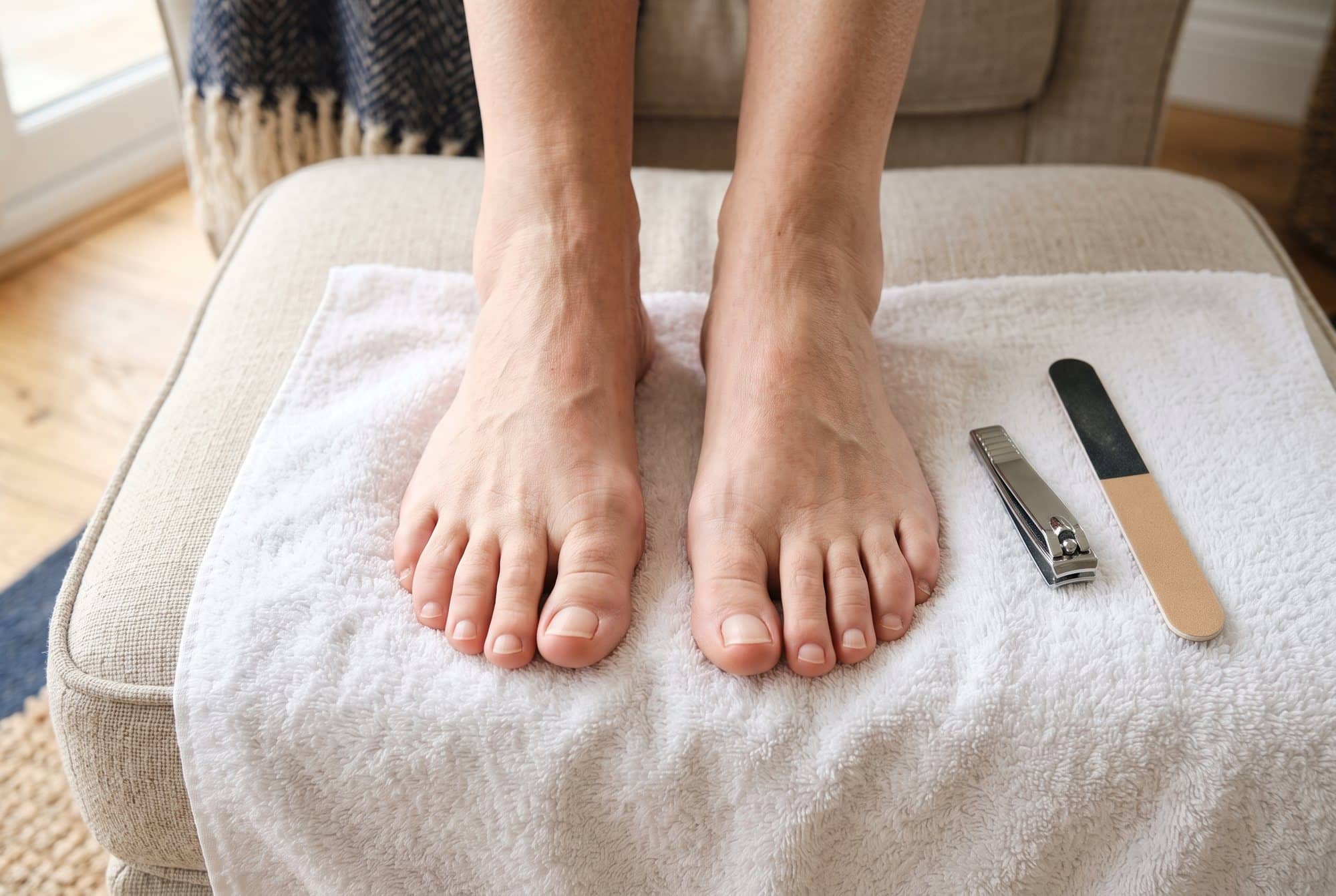
- Trim after a bath or shower, or after a soak, when nails are softer. Cleveland Clinic recommends this, along with keeping your trimmers clean.
- Use a toenail clipper, not small fingernail clippers or scissors. The AAD recommends a toenail clipper for toenails.
- Sit down in good light, with your foot resting on a stool so you can see clearly.
- Cut straight across. The AAD, the NIDDK and Cleveland Clinic all recommend it. Don't round the corners, and don't cut down into them.
- Don't cut too short. The APMA advises keeping toenails no longer than the tip of the toe, and the NHS warns against cutting them too short. Aim for about even with the tip of the toe.
- Smooth sharp edges with an emery board. The ADA and the NIDDK both recommend it. The AAD suggests filing in one direction.
- Leave the cuticles alone. The AAD notes that cuticles protect the nail root.
- Never tear or pick at a nail edge, as the APMA advises.
Toenails grow more slowly than fingernails, the AAD notes, so you may not need to trim them as often. A regular rhythm keeps them from getting long enough to catch.
If your nails are thick, yellowed or curved, or you can't see, feel or reach your feet comfortably, the NIDDK recommends having a podiatrist trim them. That's routine work for a podiatrist and much safer than struggling.
Shoes and socks that protect your toes
- Leave room for your toes. The AAD recommends shoes that fit properly, and the American Family Physician review favors a wide toe box.
- Avoid pointy or narrow toe boxes. The APMA and the NHS both advise against them.
- Alternate your shoes. The AAD recommends switching pairs from day to day.
- Keep feet clean and dry. The NHS recommends washing and drying them thoroughly.
- Choose socks that don't bunch or squeeze your toes together.
Naples life: sandals, sports and bare feet
Southwest Florida is easy on the toes in one way: open sandals give them room, and the American Family Physician review recommends open-toe or wide-toe-box footwear while an ingrown nail settles.
Our outdoor life also brings a few toe hazards:
- Bare feet on lanais, pool decks and docks make it easy to stub a toe, and toe injuries are a common cause of ingrown nails. Supportive house shoes or sandals with a closed back and a cushioned sole give your feet more protection than bare skin on pavers.
- Pickleball, tennis and long walks mean quick stops and repeated pressure on the front of the shoe. Choose athletic shoes with enough room in the toe box that your toes don't jam forward.
- Humidity and sweaty feet go together here, and excess sweating is one of the risk factors doctors list. Change damp socks, let shoes dry out between wears, and dry well between your toes after the pool or the beach.
Everyday habits that help
- Look at your feet every day, or have someone look for you.
- Ask about treatment for fungal nails, which the 2019 review lists among the factors worth managing.
- If you've had more than one ingrown nail on the same toe, ask your podiatrist whether treating the nail root makes sense.
- If trimming is getting hard, set up regular nail care with a podiatrist instead of putting it off.
A caregiver's guide to ingrown toenails
If you help a parent or spouse with their feet, you may notice an ingrown nail before they mention it. A few habits make a real difference.
Signs to watch for
- Redness or swelling along the side of a big toenail.
- Limping, favoring one foot, or trouble putting on a favorite shoe.
- Wincing when the bedsheets or a sock touch the toe.
- Fluid or crusting at the side of the nail, or a sock that's stained.
Someone with memory loss, or nerve damage in the feet, may not tell you their toe hurts. A change in how they walk, or a new reluctance to wear shoes, may be the only clue.
What you can safely do
- Check their feet in good light during bathing or dressing.
- Help with a warm soak if their podiatrist agrees: test the water yourself, keep them seated, and dry well afterward.
- Make sure their shoes have room for the toes, and that slippers have a closed back and a non-slip sole.
- Keep a short note, or a photo, of what you see, so it's easy to share with their podiatrist.
What to leave to a podiatrist
- Trimming thick, curved or brittle nails.
- Anything that involves cutting, digging or lifting a nail edge.
- Any ingrown nail in someone with diabetes, neuropathy or poor circulation.

Caregiver note
You don't have to fix an ingrown nail to help. Notice changes, keep shoes roomy and make the call early. You're welcome to book a visit for your parent, and to be there for it. With your parent's permission, we'll keep you updated on the plan.
If your loved one lives in an assisted-living or memory-care community, nail care can be part of regular on-site visits. Our article on podiatry services for nursing homes and assisted living explains how that works, and community leaders can learn more on our facilities page.
How house calls help with ingrown toenails
When your big toe hurts, getting to an office is its own problem. Shoes hurt, driving can be awkward, and waiting rooms are the last place you want to be with a throbbing toe.
With a house call, I come to you. The visit happens in your own chair, in good light, and I bring sterile instruments and everything needed for the visit. Many ingrown nail problems can be cared for right there at home, calmly and carefully, and if your situation calls for something different, I'll explain your options in plain language. Family members are welcome to join and ask questions.
A typical visit for an ingrown toenail includes:
- A review of your health history and medications.
- A look at the toe, the nail edge and the skin around it.
- A check of circulation and feeling in your feet.
- Treatment of the ingrown edge with sterile instruments, when appropriate.
- Clear instructions for soaks, dressings and shoes.
- A plan for follow-up and for keeping it from coming back.
You can read more about how house calls work, or what to expect step by step in our guide to house-call podiatry.
On insurance: I work with Medicare, Medicaid, Aetna, Cigna, Humana and UnitedHealthcare, with more plans being added. Medicare.gov explains that Part B covers medically necessary treatment for foot problems, while routine nail trimming generally isn't covered. Coverage depends on your plan and the reason for your care, so we'll check your benefits before your visit, and you'll know what's covered (and any cost) ahead of time. See our insurance section, or our guide to whether Medicare covers podiatry.
I've been practicing podiatry since 2002, and I make house calls across Naples and nearby communities, including Pelican Bay, Port Royal, Park Shore, Vanderbilt Beach, Marco Island, Bonita Springs and Estero. You can learn more about me here.
House calls in Naples
Rather have Dr. Losier take a look?
He comes to your home with sterile instruments and everything needed for the visit. We’ll check your benefits before your visit, so you’ll know what’s covered (and any cost) ahead of time.
The bottom line
An ingrown toenail is a small problem that can become a big one if it's rushed or ignored. For a mild case in an otherwise healthy adult, warm soaks, roomy shoes and patience are often enough. For anything more, including any ingrown nail in someone with diabetes, neuropathy or poor circulation, a podiatrist can take care of it safely and help keep it from coming back.
Trim straight across, give your toes room, and don't attempt bathroom surgery. And if a toe is red, swollen or draining, we're happy to come to you.
This article is general information, not medical advice. Please talk with your podiatrist or physician about your own feet and health, and never stop or change a medication without your doctor's guidance.
Common questions
A mild ingrown toenail often improves within a few days of soaking and wearing roomy shoes. After a podiatrist removes the ingrown edge, most people can return to normal activities within a few days, though the area may drain for two to three weeks while it heals. A removed section of nail takes a few months to grow back.
A mild one sometimes settles once the pressure stops and the nail grows out past the skin. Many ingrown toenails persist or get worse without proper care, though. If it's becoming more painful, red or swollen, or if you have diabetes, see a podiatrist.
No. Cutting a V-shaped notch into the nail is an old myth, and doctors list V-shaped cuts among the improper ways to trim toenails. Cut straight across instead, and let a podiatrist handle an edge that's already digging in.
Not always. A review in American Family Physician notes that antibiotics before or after treatment don't improve outcomes on their own, because removing the ingrown edge is what lets the inflammation settle. Antibiotics are used when infection spreads into the surrounding skin, and your podiatrist will decide whether you need them.
Your podiatrist numbs the toe with a local anesthetic first, so you'll feel the numbing injections but you shouldn't feel the procedure itself. Afterward, discomfort is usually minor, especially when the nail root is treated. Resting and raising your foot for the first day helps.
If only the ingrown edge is removed, that edge usually grows back over a few months and can become ingrown again. If the podiatrist also treats the nail root along that edge, called a matrixectomy, that strip usually doesn't regrow, leaving a slightly narrower nail. The rest of the nail keeps growing normally.
It's safer not to. The APMA advises people with diabetes or circulation problems to avoid self-treatment and to see a podiatrist at the first sign of trouble. Nerve damage can hide pain and poor circulation slows healing, so a small problem can become serious quickly.
Medicare Part B covers medically necessary treatment for foot problems, while routine nail trimming generally isn't covered. A painful or infected ingrown toenail is a medical problem, but exact coverage depends on your plan and situation. Dr. Losier works with Medicare, Medicaid, Aetna, Cigna, Humana and UnitedHealthcare, and we check your benefits before your visit.
Don’t see your question? Call (914) 844-8024 — a real person will help.
Sources
The health, safety and coverage facts in this article are based on these sources.
- American Family Physician — Ingrown toenail management (Mayeaux, Carter and Murphy, 2019)aafp.org(opens in a new tab)
- American Family Physician — Management of the ingrown toenail (Heidelbaugh and Lee, 2009)aafp.org(opens in a new tab)
- Cleveland Clinic — Ingrown toenails: signs, causes, treatment and preventionmy.clevelandclinic.org(opens in a new tab)
- American Podiatric Medical Association — Ingrown toenailsapma.org(opens in a new tab)
- NHS — Ingrown toenailnhs.uk(opens in a new tab)
- American Academy of Dermatology — How to trim your nailsaad.org(opens in a new tab)
- American Academy of Dermatology — 11 dermatologists' tips for healthy nailsaad.org(opens in a new tab)
- American Diabetes Association — Foot complicationsdiabetes.org(opens in a new tab)
- NIDDK — Diabetes and foot problemsniddk.nih.gov(opens in a new tab)
- Medicare.gov — Foot caremedicare.gov(opens in a new tab)
About the author
Robert Losier, DPM
Doctor of Podiatric Medicine · Practicing since 2002
Dr. Robert Losier is a Florida-licensed podiatric physician who brings unhurried foot care to patients’ homes across Naples and Southwest Florida, and on-site podiatry to care communities. A graduate of the New York College of Podiatric Medicine, he lives what he teaches — daily movement, strength training and real food — and shares practical healthy-living guidance as part of foot care.
This article is general information, not medical advice. It isn’t a substitute for an exam or for advice from your own doctor or podiatrist about your situation. Please don’t start, stop or change any medication or treatment without talking to the clinician who prescribed it. If you notice a new wound, signs of infection, or a sudden change in the color, temperature or feeling of your foot — especially if you have diabetes — contact your doctor promptly. In an emergency, call 911.