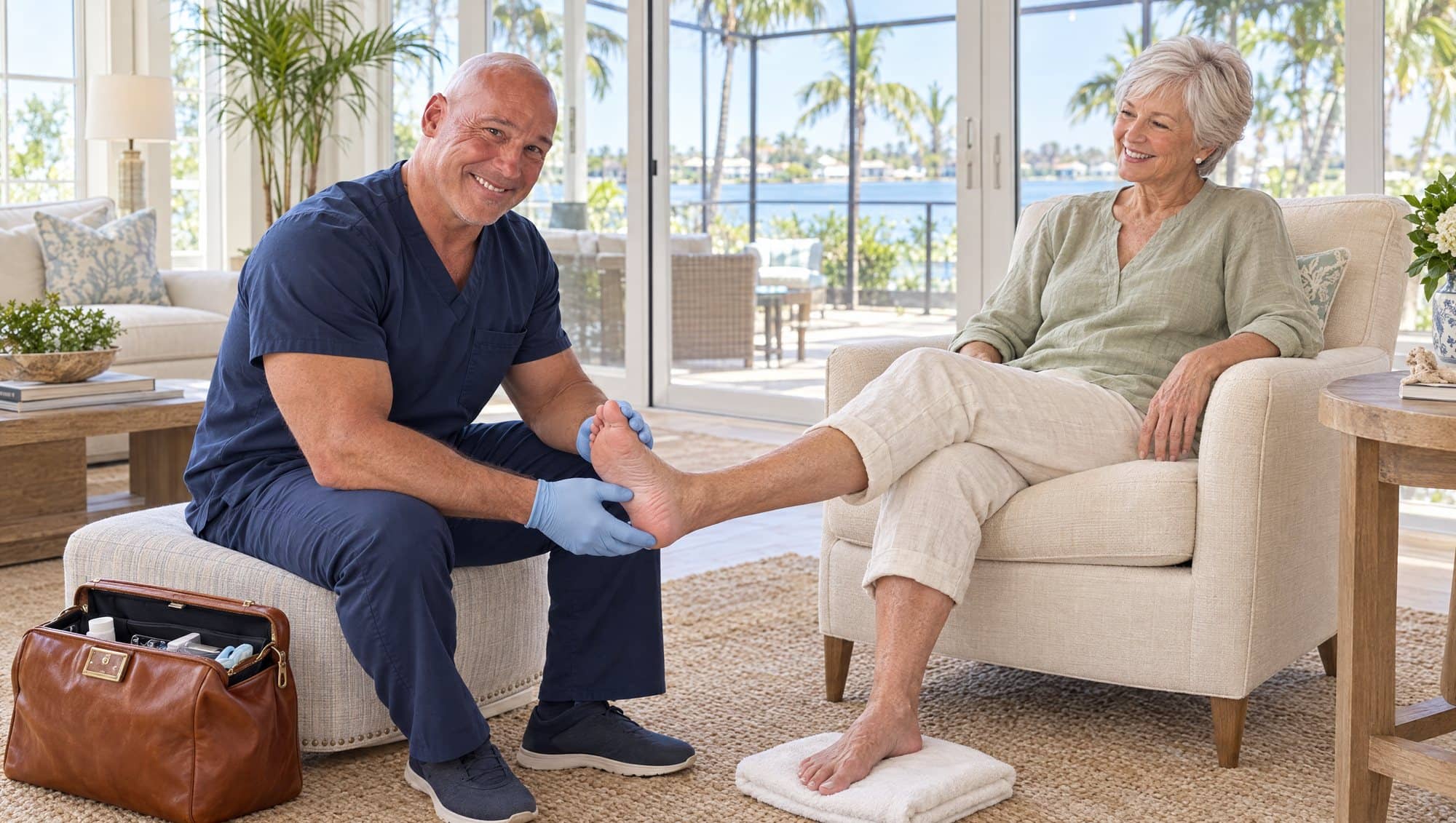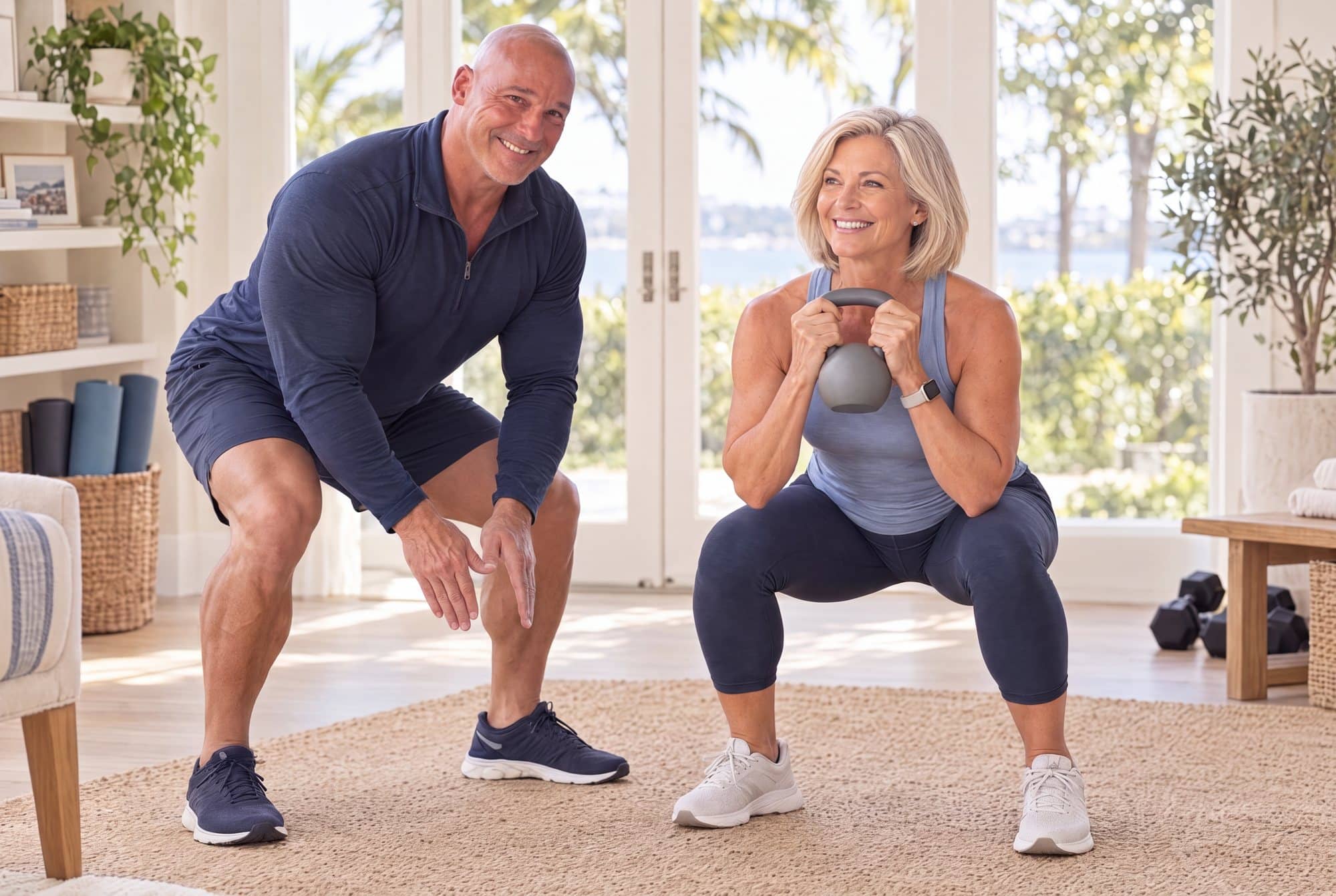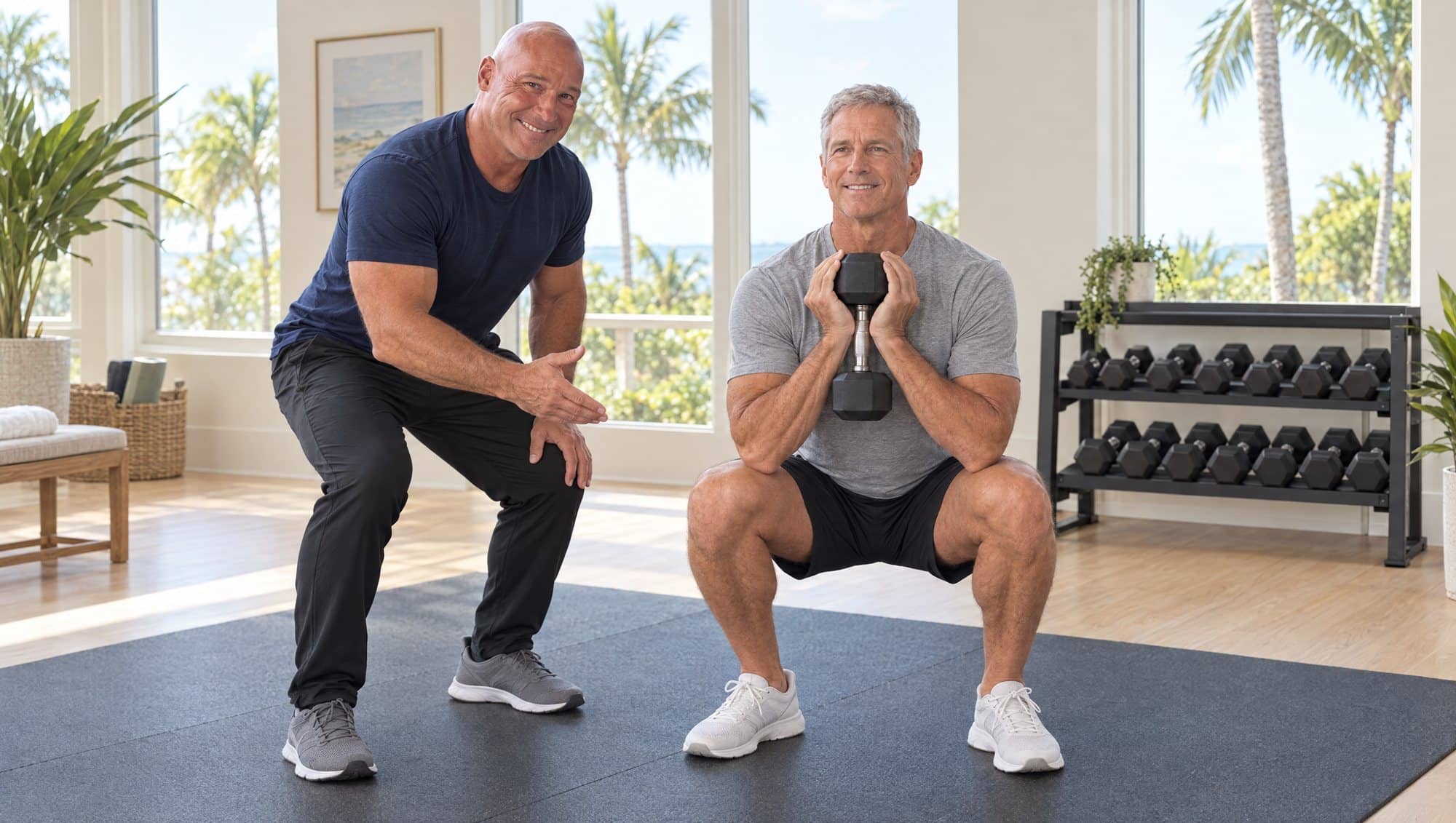
Getting up from a low sofa. Lifting a carry-on into the overhead bin. Climbing the steps up from the beach. Standing back up after kneeling in the garden. These everyday moves are really strength tests, and after 60 they quietly get harder unless you train for them.
The good news is that muscles respond to training at any age. Strength training after 60 isn’t about bodybuilding or lifting heavy on day one. It’s about doing a handful of simple movements a couple of times a week, a little better over time. I train every day myself, and as a podiatrist I think about strength from the ground up, starting with your feet.
Strength training after 60 means using your body weight, resistance bands, dumbbells or machines to make your muscles work harder than they do in daily life, then building up gradually. National guidelines recommend muscle-strengthening activities at least two days a week for adults 65 and older, working all major muscle groups, along with balance training and aerobic activity.
Key takeaways
- Adults 65 and older should do muscle-strengthening activities at least 2 days a week, working all major muscle groups, along with balance training and aerobic activity.
- Age-related muscle loss (sarcopenia) is gradual, and strength training is a powerful way to push back. Studies show strength gains even in people in their 80s and 90s.
- Start light: one set of 10 to 15 controlled repetitions of a few basic moves, two days a week. Build gradually, and put form before weight.
- Strength work does the most for falls when it’s paired with balance exercises, and good balance starts with your feet.
- Train in stable shoes with a firm, flat sole. If you have diabetes or neuropathy, don’t exercise barefoot.
- Spread protein across your meals. Ask your doctor first if you have kidney disease or another reason to limit protein.
- Stop and get help if you feel chest pain or pressure, break out in a cold sweat, or feel dizzy, lightheaded or sick to your stomach.
In this article· 13 sections
- 1Why strength training after 60 matters
- 2Is strength training safe after 60?
- 3How often should seniors strength train?
- 4What you need: shoes, bands, weights and a sturdy chair
- 5Strength exercises for older adults: 8 foundational moves
- 6Start with your feet: foot strength and balance
- 7A 4-week beginner plan
- 8How to progress without getting hurt
- 9Protein, recovery and real food
- 10Strength training with health conditions
- 11How I can help: wellness coaching in Naples
- 12Common questions
- 13Sources
Why strength training after 60 matters
Muscle loss with age is gradual, which is exactly why it’s easy to miss. According to the National Strength and Conditioning Association’s position statement on resistance training for older adults (opens in a new tab), loss of muscle mass generally begins after age 30 and speeds up after 60. Long-term studies suggest the muscles of the legs shrink by about 1% or more a year in later life.
Strength matters even more than size. The same statement notes that muscle weakness is strongly linked with disability, even after accounting for how much muscle a person has. In everyday terms, weak legs make it harder to get out of a chair, climb stairs, carry groceries and catch yourself when you trip.
What is sarcopenia?
Sarcopenia is the medical name for age-related loss of muscle mass, strength and function. The word comes from Greek roots meaning “flesh” and “loss.” The National Institute on Aging (opens in a new tab) explains that sarcopenia has been connected to weakness, fatigue, lower energy and difficulty standing, walking and climbing stairs, and that it may contribute to falls and fractures. Poor nutrition and lack of exercise raise the odds of developing it.
European geriatric specialists define sarcopenia as a progressive muscle disorder linked with a higher likelihood of falls, fractures, physical disability and death. Their 2019 consensus (opens in a new tab) puts low muscle strength first when screening. One simple measure is the chair stand test: needing more than 15 seconds to stand up from a chair five times without using your arms suggests low leg strength.
If you notice new or unexplained weakness, talk with your doctor. It could be sarcopenia, or it could be another medical condition that needs attention.
What strength training can do
The research is reassuring. A Cochrane review of 121 trials with 6,700 older participants (opens in a new tab) found that progressive resistance training, usually done two or three times a week, had a large positive effect on muscle strength. It also made getting out of a chair noticeably easier and modestly improved walking speed. People with osteoarthritis reported less pain.
It’s rarely too late to start. In a landmark 1994 study (opens in a new tab), 100 frail nursing-home residents with an average age of 87 (and up to 98) took part in 10 weeks of progressive resistance exercise. Muscle strength more than doubled in those who trained, compared with almost no change in those who didn’t. A nutrition supplement given without exercise didn’t improve weakness.
The World Health Organization notes that physical activity helps older adults prevent falls, fall-related injuries and declines in bone health and day-to-day function. And a 2022 review of large observational studies (opens in a new tab) linked muscle-strengthening activities with a 10% to 17% lower risk of early death, heart disease, cancer and diabetes, with the biggest benefit at roughly 30 to 60 minutes a week. Studies like these show associations rather than proof, but they point the same way.
Strength is independence
The National Institute on Aging puts the payoff simply: muscle-strengthening activities make everyday tasks such as getting up from a chair, climbing stairs and carrying groceries easier, and they help you stay independent. Think of every rep as an investment in the life you want to keep living.
Is strength training safe after 60?
For most people, yes, when it’s done sensibly. The National Strength and Conditioning Association concludes that a properly designed resistance training program, with good instruction on technique, is safe for healthy older adults. The NIA notes that older adults without an existing injury or chronic condition who build up gradually generally don’t need to see a doctor before becoming more active.
Check with your doctor first if…
- You have heart disease, chest pain, or blood pressure that isn’t well controlled
- You have diabetes, especially if you take insulin or other medicines that can cause low blood sugar
- You have kidney, lung or liver disease
- You have osteoporosis or have broken a bone from a minor fall
- You’ve had a recent surgery, a joint replacement or a hernia
- You’ve fallen recently, or you often feel dizzy or unsteady
- You have new symptoms you haven’t discussed with your doctor
- You simply aren’t sure. Asking is always fine.
Warm up every time
Give yourself 5 to 10 minutes. March in place or walk around the house, circle your shoulders, ankles and wrists, then do a few easy repetitions of your first exercise with no weight. The NIA recommends warming up for strength work with lighter weight or no weight at all.
Move with control, and keep breathing
- Don’t hold your breath. Breathe out during the effort (standing up, pushing, pulling) and breathe in as you return.
- Use smooth, steady movements. No swinging or bouncing.
- Don’t lock your joints. Keep a soft bend in your elbows and knees at the end of a movement.
- Learn good form early. The NIA suggests a session or two with a personal trainer, or a group class at a gym, recreation center or senior center.
Red flags
Stop exercising right away and call your doctor if you have chest pain or pressure, trouble breathing, a cold sweat, lightheadedness, dizziness or nausea, or severe joint pain or muscle cramps. Call 911 for chest pain or pressure that doesn’t go away, fainting, or sudden severe shortness of breath. Call your doctor if pain from exercise lasts more than a day or two.
Soreness or pain?
Mild muscle soreness a day or two after a new exercise is common, especially in the first few weeks. It feels like general tightness in the muscle you worked, and it eases as you move. Sharp pain, joint pain, swelling or pain that changes the way you walk is different. Stop that exercise and get it checked if it doesn’t settle quickly.
How often should seniors strength train?
Here’s what the major guidelines say, in plain English.
The CDC (opens in a new tab) recommends that adults 65 and older do muscle-strengthening activities at least 2 days a week, working all the major muscle groups: legs, hips, back, abdomen, chest, shoulders and arms. Add activities that improve balance, such as walking heel-to-toe or standing up from a sitting position, plus at least 150 minutes a week of moderate aerobic activity like brisk walking.
The Physical Activity Guidelines for Americans (opens in a new tab) add useful detail. One set of 8 to 12 repetitions of each exercise is effective, although 2 or 3 sets may be more effective. Each set should go to the point where another repetition would be difficult. Older adults should also do “multicomponent” activity, which mixes strength, balance and aerobic work, and should set their effort relative to their own fitness.
The World Health Organization (opens in a new tab) goes a step further for older adults: varied activity that emphasizes functional balance and strength training on 3 or more days a week, to improve everyday function and prevent falls.
For beginners, the NSCA suggests starting with one set of 10 to 15 repetitions at a lighter resistance, building toward 2 to 3 sets, on 2 to 3 non-consecutive days a week. It also advises stopping short of total muscle failure to reduce stress on the joints.
| Guideline | Strength | Balance | Aerobic |
|---|---|---|---|
| CDC and Physical Activity Guidelines for Americans | At least 2 days a week, all major muscle groups | Part of weekly activity (fall-prevention programs often use about 3 sessions a week) | At least 150 minutes a week of moderate activity |
| World Health Organization | At least 2 days a week, moderate or greater intensity | Functional balance and strength training on 3 or more days a week | 150 to 300 minutes of moderate activity a week |
| National Strength and Conditioning Association | 2 to 3 non-consecutive days a week; beginners start with 1 set of 10 to 15 | Include movements that mimic daily tasks | Do strength exercises before endurance work in the same session |
How hard should it feel?
Picture an effort scale from 0 (sitting still) to 10 (the hardest you could possibly work). The Physical Activity Guidelines describe moderate effort as about 5 or 6 on that scale. In your first weeks, aim for 4 to 6: the last two or three repetitions of a set should feel like work, but your form should stay clean. Over time, as your technique and confidence grow, you can work a little harder.
How long does a session take?
There’s no required time. A beginner session of six to eight exercises usually takes 20 to 40 minutes, including the warm-up and cool-down. Two sessions a week is a realistic, meaningful start.
What you need: shoes, bands, weights and a sturdy chair
You don’t need a gym membership to get started. A sturdy chair, a wall, a kitchen counter and a staircase with a handrail will take you a long way. A few inexpensive pieces of equipment help you keep progressing.
Shoes for strength training: a podiatrist’s view
Your feet are the platform for every exercise, so what you wear on them matters. Look for:
- A firm, flat, non-slip sole. The CDC’s fall-prevention fact sheet favors a thin, firm midsole so you can “feel” the ground. Very soft, thick or rocker-bottom soles can feel wobbly during squats, step-ups and balance work.
- A snug, firm heel counter that holds your heel in place.
- Laces or straps, so your foot doesn’t slide inside the shoe.
- Room in the toe box for your toes to spread, especially if you have bunions or hammertoes.
- Tread that isn’t worn smooth. Replace shoes when the soles are worn down or the heel counter has softened.
Skip socks alone or smooth-soled slippers on smooth floors, which the NIA warns against. The NIA notes that some people do balance work barefoot on a mat for grip, which can be fine if your feet are healthy. But if you have diabetes, neuropathy or poor circulation, keep your shoes on. The NIDDK advises people with diabetes not to walk barefoot, even indoors (opens in a new tab).
New rubbing, blisters or a toenail that hurts in your training shoes is worth a look. Our guides to corns and calluses and thick toenails explain the common culprits.
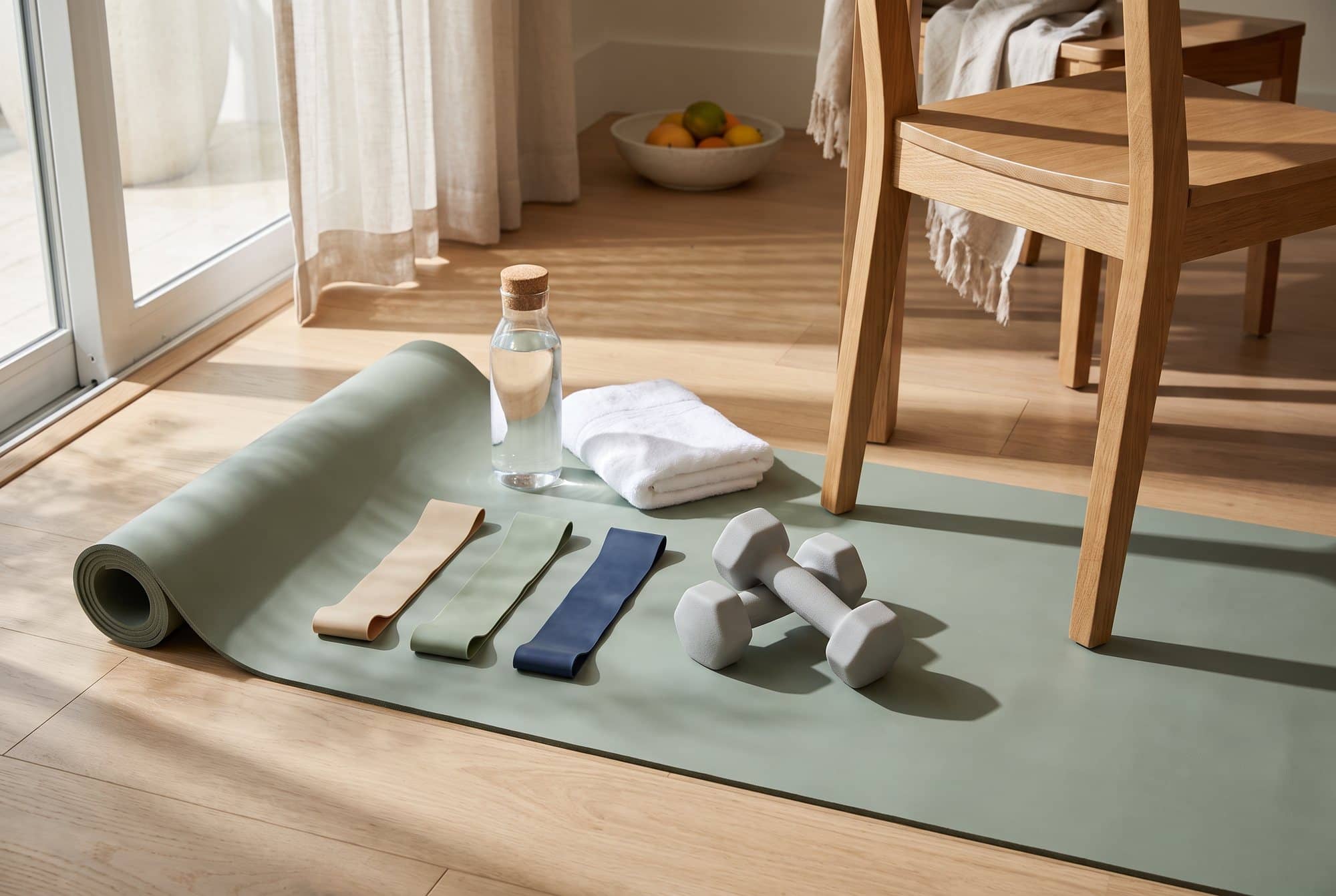
Resistance bands for seniors
Bands are light, inexpensive and easy to pack, which makes them a great fit for anyone who splits the year between Naples and somewhere else. The NSCA notes that beginners, frail older adults and people with functional limitations benefit from resistance bands and machine-based training.
- Types: Flat therapy bands, loop bands and tube bands with handles all work. Tube bands with handles are often easiest to grip.
- Resistance: Bands are usually color-coded from light to heavy, but colors vary by brand. Start with the lightest one you can use for 10 to 15 controlled reps.
- Safety: Check for nicks, tears or sticky spots before each use. Anchor bands securely; with a door anchor, use a door that opens away from you, so pulling keeps it shut. Keep the band’s path away from your face.
- Care: Store bands out of direct sun and heat. A hot Florida lanai or car isn’t the place to keep them.
Dumbbells, kettlebells or machines?
All of them can build strength. The NSCA notes that machines, bands and simple holds are good starting points for beginners, while people who are already fit gain added benefit from dumbbells, kettlebells and other hand-held weights.
Start with a light pair of dumbbells that you can lift 12 to 15 times with good form. Adjustable dumbbells save space, but simple fixed weights are easier to grab and go. For a very light start, filled water bottles work too.
The rest of your home gym
- A sturdy, armless chair that you can place with its back against a wall
- A kitchen counter or heavy table to hold for balance
- The bottom step of a staircase with a secure handrail
- An exercise mat, but only if you can get down to the floor and back up safely
- A water bottle, and a notebook or phone to log your sessions
Strength exercises for older adults: 8 foundational moves
These eight moves cover the major muscle groups the CDC lists. They’re a starting point, not the only “right” exercises. Do them slowly and with control, and stop any exercise that causes sharp pain.
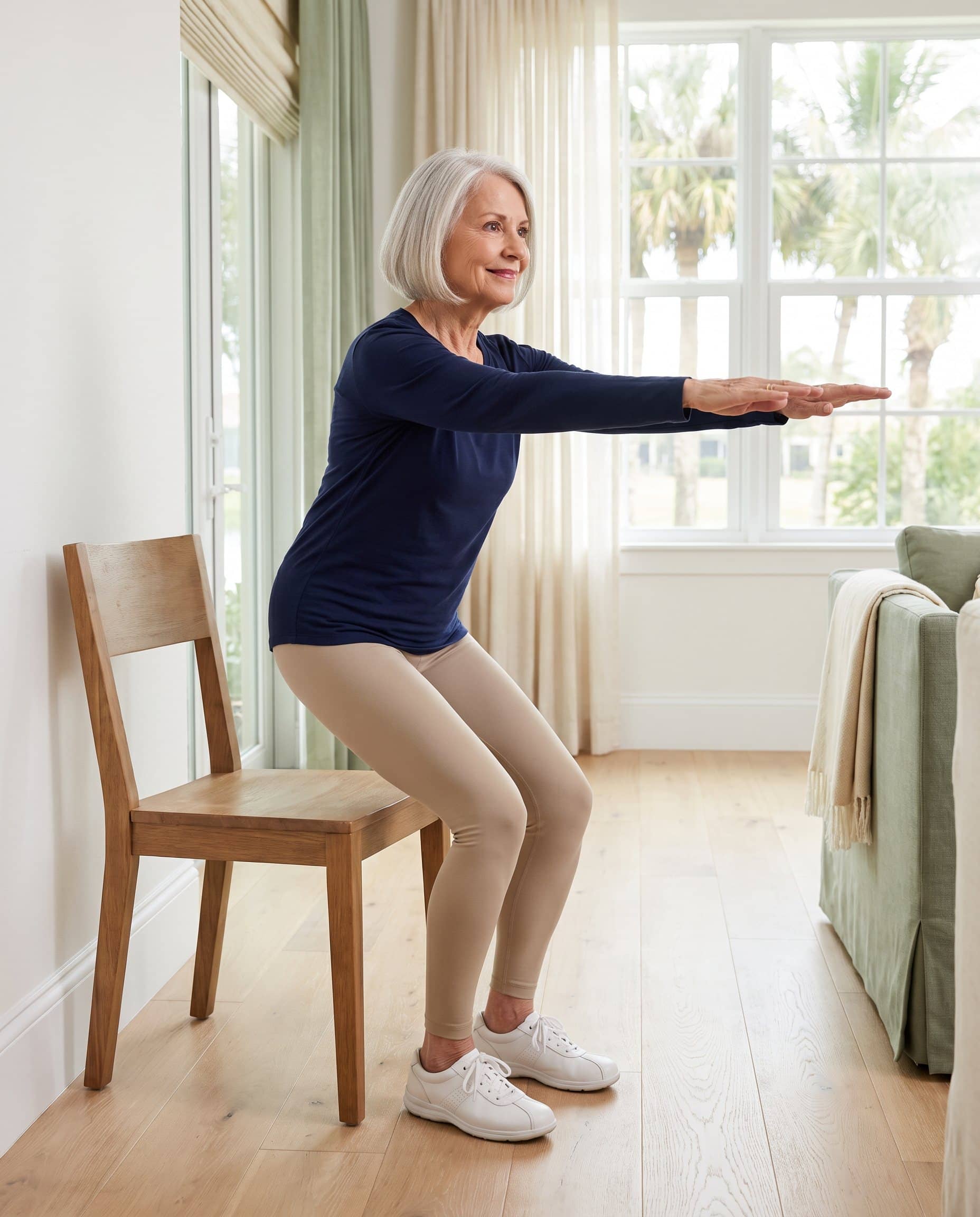
1. Sit-to-stand (chair squat)
Works: Thighs, hips and buttocks, the muscles you use to get out of a chair, out of a car and up from the toilet.
- Place a sturdy, armless chair with its back against a wall. Sit toward the front edge, feet flat and hip-width apart, slightly behind your knees.
- Cross your arms over your chest, or reach them forward at shoulder height for balance.
- Lean your chest forward (think “nose over toes”) and press through your whole foot to stand up tall.
- Reverse slowly. Push your hips back and lower yourself with control, taking about three seconds to sit. Don’t drop into the chair.
Form cues: Knees track in line with your toes, heels stay down, and you breathe out as you stand.
Easier: Use your hands on your thighs or the chair seat, or add a firm cushion to raise the seat.
Harder: Lower more slowly, pause just above the seat, or hold a light dumbbell at your chest (a goblet squat).
2. Wall or counter push-up
Works: Chest, shoulders and the backs of your arms.
- Stand facing a wall, a little farther than arm’s length away, with your feet shoulder-width apart.
- Place your palms flat on the wall at shoulder height and shoulder-width apart.
- Breathe in as you bend your elbows and lower your chest toward the wall in a slow, controlled motion. Keep your feet flat.
- Pause, then breathe out and push back until your arms are straight, without locking your elbows.
Form cues: Keep your body in one straight line from head to heels, and let your elbows angle back slightly instead of flaring straight out.
Easier: Stand a little closer to the wall.
Harder: Move to a sturdy kitchen counter, which puts more of your body weight into the move.
3. Band row
Works: Upper back and the backs of the shoulders, the muscles that help you stand tall.
- Anchor the middle of a band at about chest height in front of you. A door anchor in a closed door works well.
- Sit tall in a sturdy chair facing the anchor (or stand with your feet hip-width apart), holding one end of the band in each hand with your arms straight and a little tension in the band.
- Squeeze your shoulder blades together and pull your elbows back past your ribs.
- Pause, then return slowly.
Form cues: Shoulders down and away from your ears, wrists straight, and no leaning back to help.
Easier: Move a step closer to the anchor to reduce the tension.
Harder: Step back a little, use a stronger band, or pause for two seconds at the back.
4. Step-ups
Works: Legs and hips, with a built-in balance challenge.
- Stand facing the bottom step of a staircase that has a sturdy handrail, and hold the rail.
- Place your whole right foot on the step and press through it to stand up onto the step, bringing your left foot up beside it.
- Step down with your left foot, then your right.
- Do 8 to 10 starting with the right leg, then switch.
Form cues: Whole foot on the step, knee in line with your toes, and stand up tall once you’re on the step. Keep one hand on the rail every time.
Easier: Use a lower step, or make smaller, slower movements.
Harder: Take longer on the way down, or hold a light dumbbell in your other hand.
5. Back leg raises
Works: Buttocks and lower back.
- Stand behind a sturdy chair or at the counter, holding on with both hands, feet slightly apart.
- Breathe out as you slowly lift one leg straight back, without bending your knee or pointing your toes. Don’t lean forward.
- Hold for one second, then breathe in as you lower it.
- Do 10 on each side.
Form cues: Stand tall and move only the leg. A small lift done well beats a big swing.
6. Side leg raises
Works: The hip muscles that keep you steady from side to side.
- Stand at the counter or behind a sturdy chair, holding on with both hands.
- Keeping your body upright and your toes facing forward, slowly lift one leg out to the side.
- Lower slowly. Do 10 on each side.
Form cues: Don’t lean toward the standing leg, and keep the lifted foot pointing forward, not up.
7. Seated overhead press
Works: Shoulders and the backs of the arms.
- Sit tall in a sturdy chair with your feet flat. Hold a light dumbbell in each hand at shoulder height, palms facing forward or facing each other, whichever is more comfortable.
- Breathe out as you press the weights up until your arms are nearly straight. Don’t lock your elbows.
- Lower slowly back to shoulder height.
Form cues: Keep your ribs down and avoid arching your lower back. The weights should travel straight up over your shoulders.
If your shoulders complain: Press only as high as feels comfortable, or raise the weights out to the sides to shoulder height instead. Mention shoulder pain to your doctor.
8. Suitcase carry
Works: Grip, shoulders, trunk and legs. It’s practice for carrying groceries, which the Physical Activity Guidelines count as a muscle-strengthening activity.
- Pick up a light dumbbell or a sturdy bag in each hand by bending your knees and hips while keeping your back straight.
- Stand tall with your shoulders back and down, and walk 20 to 30 steps down a clear hallway at an easy pace.
- Set the weights down the same way you picked them up.
Form cues: Don’t lean to either side, and walk with your normal stride.
Safety: If your balance is shaky, carry one light weight and keep your other hand on a counter, or skip this move until your balance improves.
You may notice there are no sit-ups. Standing moves like carries, rows and step-ups train your trunk muscles as they work to keep you upright.

Wellness consulting
Want a plan that fits your life?
One-on-one coaching on strength, balance, everyday nutrition and recovery — the fundamentals, done right. No peptides, no supplement stacks.
Start with your feet: foot strength and balance
Every exercise above starts at the floor. Your feet are your base of support, and they’re also sensors that tell your brain where your weight is. Your toes grip the ground and your calves lift and steady you.
Research on older adults links weak toe muscles, foot pain and reduced feeling in the feet to a higher risk of falling. The encouraging part is that foot muscles respond to training, too. In one 12-week study (opens in a new tab) of people aged 60 to 90, a supervised, progressive foot-strengthening program increased toe strength by up to 36%.
Strength alone isn’t the whole answer to falls, though. A Cochrane review of exercise for preventing falls (opens in a new tab) found that programs built on balance and functional exercises reduced falls, and that programs combining balance work with strength training probably reduced the rate of falls by about a third. Programs that were mainly strength training had less certain effects on falls. So pair your strength sessions with the foot and balance work below, about three days a week.
Foot exercises (seated)
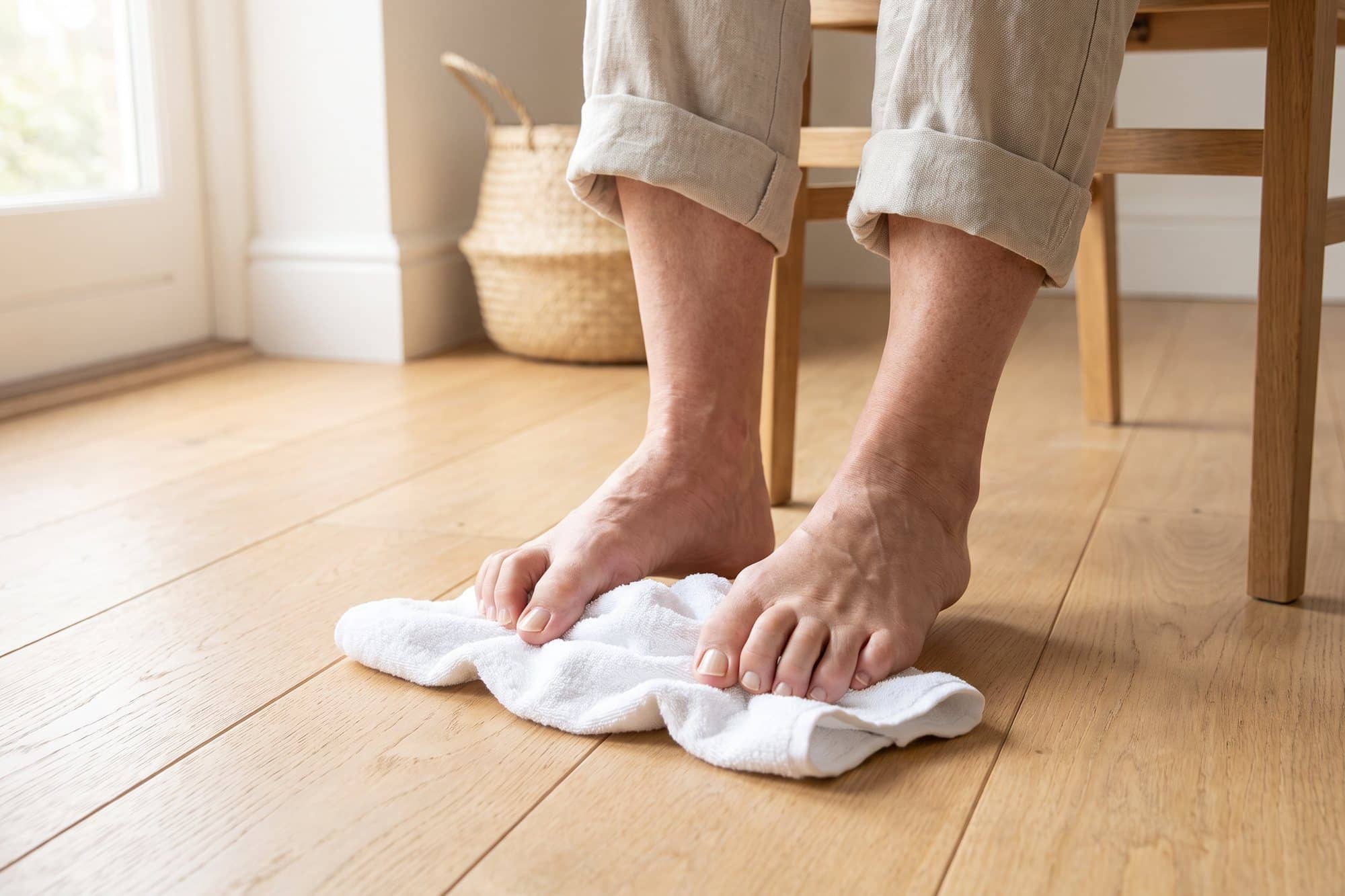
- Towel scrunches. Sit with a small towel flat under your feet. Curl your toes to scrunch the towel toward you, then relax and spread your toes. Repeat 10 times.
- Toe spreads. Spread your toes as wide as you can, hold for five seconds, then relax. Repeat 10 times.
- Big-toe press, little-toe lift. Press your big toe into the floor while lifting the other four toes. Then switch: press the four small toes down while lifting the big toe. Do 10 of each. It feels awkward at first, and that’s normal.
- Arch lifts. With your toes long and relaxed (not curled), gently draw the ball of your foot toward your heel so your arch rises slightly. Hold for five seconds, and repeat 10 times.
If you have diabetes or neuropathy, check with your podiatrist before doing foot exercises barefoot, and look over your feet for redness afterward.
Heel raises (standing)
- Stand facing the counter, feet hip-width apart, both hands resting on the edge.
- Rise slowly onto the balls of your feet, pause, and lower over about three seconds.
- Start with 8 to 10. Build to 2 sets of 10 to 15.
- When that’s easy, try single-leg heel raises with both hands still on the counter.
Balance exercises (at the counter)
- One-leg stand. Hold the counter and lift one foot slightly. Hold for 10 seconds, then switch. Work up to longer holds over the weeks.
- Heel-to-toe stand and walk. Place one foot directly in front of the other, heel touching toe, and hold for 10 seconds. When that’s easy, walk heel-to-toe along the counter with a hand on it.
- Side steps. Facing the counter with your hands on it, step sideways along its length and back.
As you improve, reduce support gradually: two hands, then one, then fingertips, always with the counter within reach. Tai chi and community balance classes are other good options. For a deeper look at feet and falls, read our guide to fall prevention for seniors.
Tip
Pair balance work with something you already do. Practice one-leg stands at the counter while the kettle boils, or heel raises while you brush your teeth. A few minutes, most days, adds up.
A 4-week beginner plan
This plan is general and deliberately conservative. It assumes you’re new to strength training or returning after a long break.
Good to know
Check with your doctor before you start, especially if you have heart, lung or kidney disease, diabetes, osteoporosis, a recent surgery or joint replacement, or you’ve had a fall. If an exercise hurts, skip it and ask about an alternative.
What a session looks like
- Warm-up (5 to 10 minutes): March in place or walk around the house, roll your shoulders and ankles, and do a few practice reps with no weight.
- Strength (20 to 30 minutes): Work through the week’s exercises. Rest a minute or two between sets.
- Balance and feet (5 to 10 minutes): One-leg stands, heel-to-toe and a couple of foot exercises.
- Cool-down (5 minutes): An easy walk, then gentle stretches for your calves, thighs and chest. Stretch only to mild tension, never to pain.
Your four weeks
| Week | Days | What to do | Sets, reps and effort |
|---|---|---|---|
| 1 | 2 | Learn five moves with body weight or the lightest band: sit-to-stand, wall push-up, band row, back leg raises, heel raises | 1 set of 8–10, at about 4–5 out of 10 |
| 2 | 2 | Same five moves, plus step-ups and side leg raises | 1–2 sets of 10–12, at about 5 out of 10 |
| 3 | 2–3 | Add light dumbbells or the next band, plus the seated overhead press | 2 sets of 10–12, at 5–6 out of 10 |
| 4 | 2–3 | Add the suitcase carry, and make one or two moves a little harder | 2 sets of 10–15, at about 6 out of 10 |
Leave at least one rest day between strength days (Monday and Thursday works well). Every week, add the foot and balance work about three days a week, and walk on most days, building toward the CDC’s target of 150 minutes of moderate activity a week.
A sample week
| Day | Plan |
|---|---|
| Monday | Strength session, then 5 minutes of balance work |
| Tuesday | 20- to 30-minute walk and seated foot exercises |
| Wednesday | Rest, or gentle stretching |
| Thursday | Strength session, then 5 minutes of balance work |
| Friday | 20- to 30-minute walk |
| Saturday | Balance and foot work, or a tai chi class (an optional third strength session in weeks 3 and 4) |
| Sunday | Rest, or an easy walk with family or friends |
If you miss a week, repeat the previous week instead of jumping ahead. Progress isn’t a straight line, and consistency beats intensity.
How to progress without getting hurt
Strength comes from asking your muscles to do a little more than they’re used to, gradually. The Physical Activity Guidelines describe it simply: increasing the weight, the number of sets or repetitions, or the number of days a week, over time, results in stronger muscles. These rules of thumb keep the process steady.
- Change one thing at a time. Add reps first, then a set, then resistance. Never all three at once.
- Use the “two extra reps” rule. When you can do two more repetitions than your target, with good form, two sessions in a row, it’s time for a slightly heavier weight or the next band.
- Make small jumps. Move to the next lightest dumbbell or the next band, not a big leap.
- Form comes first. If your form slips, the weight is too heavy for now.
- Stop short of failure. Finish each set when one or two more reps would be hard, not impossible. The NSCA advises avoiding training to failure to reduce joint stress.
- Rest the same muscles for a day. The NIA recommends not working the same muscle group two days in a row.
- Ease back after a break. After an illness, a trip or a busy stretch, return at a lighter level and build back up over a week or two.
Track your progress
Keep a simple log of each exercise, the band or weight you used, and your sets and reps. Many people find it motivating to see the numbers creep up.
You can also retest your leg strength every four weeks with the CDC’s 30-second chair stand, a screening tool from the STEADI fall-prevention program. Use an armless chair with a seat about 17 inches high, placed against a wall, and have someone stand next to you for safety. Sit in the middle of the chair with your arms crossed at the wrists against your chest. On “go,” stand all the way up and sit back down as many times as you can in 30 seconds. If you need your arms to stand, stop. That result is useful to share with your doctor.
The CDC lists these as below-average scores, which can signal a higher risk of falling:
| Age | Men: below average if fewer than | Women: below average if fewer than |
|---|---|---|
| 60–64 | 14 stands | 12 stands |
| 65–69 | 12 stands | 11 stands |
| 70–74 | 12 stands | 10 stands |
| 75–79 | 11 stands | 10 stands |
| 80–84 | 10 stands | 9 stands |
| 85–89 | 8 stands | 8 stands |
| 90–94 | 7 stands | 4 stands |
This is a screening reference, not a diagnosis. A below-average score is a reason to talk with your doctor and keep training, not a reason to worry.
Beyond the first month
Keep training two or three days a week, and keep progressing slowly. Over months, many healthy older adults can work up to two or three sets of more challenging loads. The NSCA’s position statement describes working toward heavier resistance for healthy older adults, along with some faster “power” movements, such as standing up from a chair briskly, done with a controlled return. Those steps go more smoothly with a qualified coach or trainer who can watch your form.
Protein, recovery and real food
Muscles are built in the hours and days after training, and what you eat and how you rest matter. This section is general education, not a personal nutrition plan.
How much protein?
Older adults often need fewer calories but just as much protein, or more. The Dietary Guidelines for Americans, 2025–2030 (opens in a new tab) make this point and set a protein goal for adults of 1.2 to 1.6 grams per kilogram of body weight a day, adjusted to individual calorie needs. They also recommend prioritizing protein foods at every meal.
Geriatric research groups land in a similar place. The PROT-AGE study group (opens in a new tab) recommends at least 1.0 to 1.2 grams per kilogram a day for healthy adults over 65, and at least 1.2 for those who exercise or are otherwise active. It notes an important exception: people with severe kidney disease who aren’t on dialysis may need to limit protein.
To translate grams per kilogram, divide your weight in pounds by 2.2. For example, a 150-pound person weighs about 68 kilograms, so 1.2 grams per kilogram works out to about 82 grams of protein a day, spread across meals. That’s an illustration, not a prescription. If you have kidney disease or another condition that affects your diet, follow your doctor’s guidance. Your doctor can help you personalize these numbers.
Real-food protein, at every meal
- Eggs, Greek yogurt, cottage cheese and milk
- Fish and shellfish, a natural fit for a Gulf Coast kitchen
- Chicken, turkey and lean meats
- Beans, lentils, peas, tofu and other soy foods
- Nuts and seeds
If most of your protein shows up at dinner, try adding some at breakfast and lunch. Eggs, yogurt or last night’s salmon on a salad are easy places to start.
You don’t need a supplement stack
Strength is built with training, food and rest. In the 1994 nursing-home study, a nutrition supplement on its own didn’t improve muscle weakness, while the exercise did. If you’re curious about protein shakes or any supplement, ask your physician, especially if you take medicines or have kidney disease. For more on this approach, read healthy aging without supplement stacks.
Recovery basics
- Sleep. Regular, sufficient sleep supports recovery, and the NIA notes that being tired makes falls more likely.
- Rest days. Give each muscle group at least a day between strength sessions. Gentle walking on rest days is fine.
- Water. Drink water through the day, especially in Florida heat, unless your doctor has told you to limit fluids.
- Listen to your body. The NIA cautions that overdoing muscle-strengthening exercise can cause exhaustion, sore joints and muscle pain or injury. A lighter day is still a good day.
Wellness consulting
Want a plan that fits your life?
One-on-one coaching on strength, balance, everyday nutrition and recovery — the fundamentals, done right. No peptides, no supplement stacks.
Strength training with health conditions
Almost anyone can do some kind of strength training, and the NIA notes that older adults with chronic conditions can benefit from physical activity. The key is to adjust, not avoid.
Diabetes and neuropathy
Physical activity helps older adults manage type 2 diabetes. The NIA advises aiming for at least 150 minutes a week of moderate aerobic activity plus two days of muscle-strengthening activity, and notes that people with diabetes must be especially careful about monitoring blood glucose, choosing appropriate footwear and avoiding foot injuries. Follow your care team’s advice on checking your blood sugar around exercise. Wear shoes for every session, and check your feet afterward for blisters, redness or rubbing. Our diabetic foot care guide covers daily checks in detail.
Arthritis
The NIA notes that older adults with arthritis who stay active often have less pain and better function, and that aerobic and muscle-strengthening activities both contribute. Work in a comfortable range of motion and favor low-impact choices. If a joint is swollen, hot or newly painful, rest it for a day or two and work other areas, and talk with your doctor if it doesn’t settle.
Osteoporosis
Talk with your health care provider about which activities are safe for you. The NIA notes that a combination of exercise types, including weight-bearing, muscle-strengthening and balance exercises, can help build and maintain healthy bones and prevent falls and fractures. Ask specifically which movements you should avoid.
High blood pressure
Both aerobic and muscle-strengthening activities are beneficial for people with high blood pressure, according to the NIA. Breathe steadily through every repetition, never holding your breath, and keep your health care provider informed as you become more active.
Heart or lung disease
Check with your doctor before starting. Supervised programs such as cardiac or pulmonary rehabilitation can be a safe way to begin and to learn your limits.
Joint replacement or recent surgery
Follow your surgeon’s and physical therapist’s guidance on which movements are allowed and when. Your rehab exercises count as strength training.
Caregiver note
If you’re helping a parent with memory loss stay active, the NIA suggests exercising together and keeping expectations realistic. Several short “mini workouts” may work better than one long session. Choose simple, familiar moves like sit-to-stands and supported heel raises, and stay close by for safety.
How I can help: wellness coaching in Naples
Fitness has been part of my life for as long as I can remember, and I train every day. I coach the same simple fundamentals I practice myself: strength, balance, real food and rest. No peptides, no supplement stacks, and nothing to sell you.
My wellness coaching is education and coaching on healthy-living habits. It is not medical care, and your physician stays in charge of your health. Here’s how it works:
- A real conversation about your goals, your history, and what has and hasn’t worked.
- Your baseline: your goals and habits, a simple movement and balance check, and lab work ordered through your physician if it’s useful.
- A simple plan with a handful of clear priorities built around your life.
- Check-ins to adjust, celebrate progress and keep you on track.
Sessions happen wherever suits you around Naples: at home, at your gym or club, or outdoors, with phone check-ins while you’re away for the season. Coaching is typically private-pay and separate from insurance-covered podiatry visits. Results vary with consistency, and I don’t promise specific outcomes.
As a podiatrist, I also watch the ground floor. If heel pain, a painful corn or a toenail that rubs is holding you back, that’s podiatry, and I can see you at home. You can learn more about me, see how house calls work, or get in touch to start the conversation.
The bottom line
Strength training after 60 doesn’t require a gym, a big time commitment or heavy weights. It takes a sturdy chair, a few simple moves, two or three short sessions a week and the patience to build gradually. Add balance work that starts with your feet, eat real food with protein at every meal, rest well, and keep showing up.
Check with your doctor before starting a new exercise program, especially if you have a health condition.
Common questions
It’s rarely too late. In a classic study, frail nursing-home residents with an average age of 87 more than doubled their muscle strength after 10 weeks of progressive resistance training. Start where you are, build gradually, and check with your doctor first if you have health conditions.
The CDC recommends muscle-strengthening activities at least 2 days a week for adults 65 and older, working the legs, hips, back, abdomen, chest, shoulders and arms. Leave a day of rest between sessions that work the same muscles, and add balance training about 3 days a week.
Start with your body weight or a light band, and choose a resistance you can move 10 to 15 times with good form. The last two or three repetitions should feel like work, not a struggle. Increase the challenge only when the movement feels easy and controlled.
Yes. Bands are light, inexpensive and easy to travel with, and the National Strength and Conditioning Association notes that beginners and people with functional limitations benefit from bands and machines. Check bands for nicks or tears before each use, and anchor them securely.
The 2025–2030 Dietary Guidelines for Americans set a protein goal of 1.2 to 1.6 grams per kilogram of body weight a day for adults, and geriatric research groups recommend at least 1.0 to 1.2 for healthy older adults. Spread it across your meals. If you have kidney disease, follow your doctor’s guidance.
Stronger legs help, but the strongest evidence is for programs that combine balance and functional exercises with strength work. A Cochrane review found that combined programs probably reduce falls by about a third. That’s why this plan includes balance and foot exercises.
Choose a stable shoe with a firm, flat, non-slip sole, a snug heel and laces or straps. Very soft or worn-out soles can feel wobbly. If you have diabetes, neuropathy or poor circulation, keep shoes on for every workout.
Yes. Dr. Losier offers wellness coaching in Naples on strength, balance, real food and rest, at home, at your gym or club, or outdoors. It’s education and coaching, not medical care, and it’s typically private-pay and separate from insurance-covered podiatry visits.
Don’t see your question? Call (914) 844-8024 — a real person will help.
Sources
The health, safety and coverage facts in this article are based on these sources.
- CDC — Older Adult Activity: An Overviewcdc.gov(opens in a new tab)
- U.S. Department of Health and Human Services — Physical Activity Guidelines for Americans, 2nd editionodphp.health.gov(opens in a new tab)
- Bull FC et al. World Health Organization 2020 guidelines on physical activity and sedentary behaviour. British Journal of Sports Medicine, 2020pmc.ncbi.nlm.nih.gov(opens in a new tab)
- National Institute on Aging — Exercise and Physical Activity for Older Adults: Staying Active as You Ageorder.nia.nih.gov(opens in a new tab)
- Fragala MS et al. Resistance Training for Older Adults: Position Statement From the National Strength and Conditioning Association. Journal of Strength and Conditioning Research, 2019nsca.com(opens in a new tab)
- Liu CJ, Latham NK. Progressive resistance strength training for improving physical function in older adults. Cochrane Database of Systematic Reviews, 2009pmc.ncbi.nlm.nih.gov(opens in a new tab)
- Cruz-Jentoft AJ et al. Sarcopenia: revised European consensus on definition and diagnosis. Age and Ageing, 2019pmc.ncbi.nlm.nih.gov(opens in a new tab)
- U.S. Department of Agriculture and HHS — Dietary Guidelines for Americans, 2025–2030cdn.realfood.gov(opens in a new tab)
- Bauer J et al. Evidence-based recommendations for optimal dietary protein intake in older people: a position paper from the PROT-AGE Study Group. JAMDA, 2013pubmed.ncbi.nlm.nih.gov(opens in a new tab)
- American Academy of Family Physicians — What Seniors Should Know About Exerciseaafp.org(opens in a new tab)
About the author
Robert Losier, DPM
Doctor of Podiatric Medicine · Practicing since 2002
Dr. Robert Losier is a Florida-licensed podiatric physician who brings unhurried foot care to patients’ homes across Naples and Southwest Florida, and on-site podiatry to care communities. A graduate of the New York College of Podiatric Medicine, he lives what he teaches — daily movement, strength training and real food — and shares practical healthy-living guidance as part of foot care.
This article is general information, not medical advice. It isn’t a substitute for an exam or for advice from your own doctor or podiatrist about your situation. Please don’t start, stop or change any medication or treatment without talking to the clinician who prescribed it. If you notice a new wound, signs of infection, or a sudden change in the color, temperature or feeling of your foot — especially if you have diabetes — contact your doctor promptly. In an emergency, call 911.